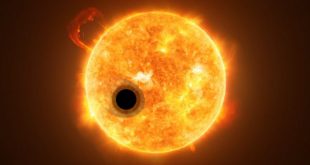
Astronomers are looking forward to getting data from the recently launched Transiting Exoplanet Survey Satellite (TESS), but speed will be of the essence when analyzing that data. To prepare, researchers from MIT and other institutions have used a batch of data from the Kepler spacecraft to test how quickly they …
Read More »Dinosaurs Couldn’t Stick Out Theirs Tongues, New Study Shows
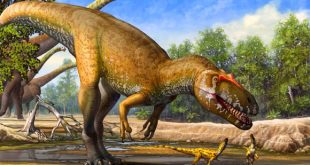
Reconstructions of dinosaurs at theme parks and museums often show their tongues waving — a feature that is completely incorrect. According to new research, published in the journal PLoS ONE, dinosaur tongues were probably rooted to the bottoms of their mouths in a manner akin to extant alligators. Dinosaurs couldn’t …
Read More »Study: Nocturnally Migrating Insects Use Earth’s Magnetic Field to Navigate
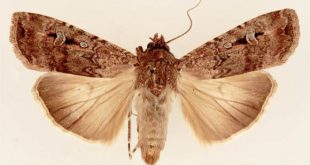
Like many migrating birds, numerous species of nocturnal moths undertake long-distance migrations at night. Each spring, billions of Bogong moths (Agrotis infusa) escape hot conditions in different regions of southeast Australia by making a migration of over 600 miles (1,000 km) to cool caves in the Australian Alps; after a …
Read More »Extinct Gibbon Found in 2,250-Year-Old Tomb of Chinese Noblewoman
The remains of a previously unknown genus and species of gibbon, Junzi imperialis, have been found in an approximately 2,200-2,300 year-old royal tomb in Shaanxi province, China. Gibbons at play (c. 1427) by the Xuande Emperor, the fifth emperor of the Ming dynasty of China. Gibbons (family Hylobatidae) have played …
Read More »Martian Dust Storm Is Now a ‘Planet-Encircling’ Event
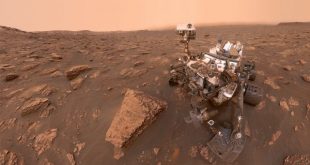
The dust storm raging on Mars shows no signs of abating. In fact, it’s still growing in size. NASA says the storm is now a “global” event that completely encircles the planet. The little Opportunity rover is still snoozing through it thanks to a lack of light, but Curiosity is …
Read More »Bees Prefer Specific Wavelength Range of Blue Fluorescent Light
A team of scientists from Oregon State University and the University of Minnesota, Saint Paul, has learned that blue fluorescent light in the 430- to 480-nm range set wild bees abuzz. Ostroverkhova et al examined responses of wild bees to traps designed to selectively stimulate either the blue or the …
Read More »‘16:8 Diet’ is Effective for Weight Loss, Finds New Study
A new study published in the journal Nutrition and Healthy Aging is the first to examine the effect of the 16:8 diet — named for its 16 hours of fasting and its 8 hours of feasting — on weight loss in obese adults. The 8-h time restricted feeding produces mild …
Read More »Scientists Find High Levels of Two Herpesvirus Strains in Brains of Alzheimer’s Disease Patients
Herpesviruses 6A and 7 (HHV-6A and HHV-7) — two of the nine known members of the Herpesviridae family that infect humans — are found in the brains of patients with Alzheimer’s disease at levels up to twice as high as in those without Alzheimer’s, according to a new study appearing …
Read More »Mysterious Martian Rocks Finally Explained
The Mars of today is almost entirely geologically inert, but that was not always the case. Scientists believe they’ve identified a process that created the previously unexplained Medusae Fossae formations on the planet’s surface. Researchers have used data from orbiting spacecraft to point the finger at a massive volcanic event …
Read More »Organic Molecules on Ceres Are More Abundant Than Previously Thought
Dawn has been in orbit of Ceres since March, 2015 and its three-year examination of the dwarf planet has vastly expanded our understanding of its nature and composition. In February 2017, NASA announced it had detected organic molecules on the surface of Ceres. Now, new evidence suggests there are more …
Read More »
#Bizwhiznetwork.com Innovation ΛI |Technology News