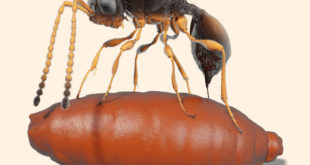
A research team led by Karlsruhe Institute of Technology scientist Thomas van de Kamp has found ancient parasitoid wasps lurking inside 55 mineralized fly pupae from the Paleogene period (66-23 million years ago). Illustration of a female Xenomorphia resurrecta ovipositing into a puparium. Image credit: van de Kamp et al, …
Read More »Paleontologists Discover Three New Fossil Primates
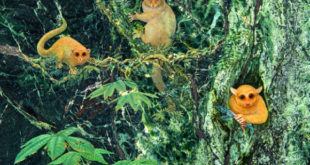
Paleontologists at the University of Texas at Austin have identified three new species of omomyine primates that lived between 42 and 46 million years ago (Eocene epoch). Artist’s rendering of what Ekwiiyemakius walshi, Gunnelltarsius randalli and Brontomomys cerutti might have looked like. Image credit: Randy Kirk, University of Texas at …
Read More »Jurassic Mammal Precursor Had Tiny Brain
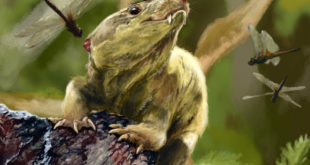
A team of paleontologists from the University of Texas at Austin has uncovered fossils of an adult female Kayentatherium wellesi — an extinct tritylodontid cynodont that lived alongside dinosaurs about 185 million years ago (Jurassic period) — and her babies (at least 38 individuals). The find is among the best …
Read More »New Jersey Fossils Shed Light on Theropod Dinosaurs of Eastern United States
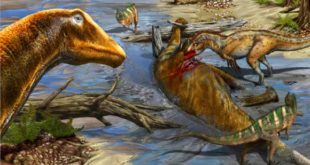
On the east coast of North America, dinosaur fossils are rare finds. Owing to several factors, such as the mass-urbanization of the eastern seaboard, fossils from these incredible creatures are few and far between. Even the most complete skeletons are incomplete, making nearly any stray chunk of bone from the …
Read More »Mesosaurs: ‘Oldest-Known Aquatic Reptiles’ Were Semi-Aquatic, Paleontologists Say
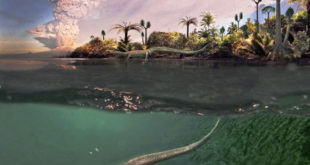
According to new research published in the journal Frontiers in Ecology and Evolution, mesosaurs — the oldest known reptiles that developed aquatic adaptations — spent part of their life on land. Mesosaurus. Image credit: Roman Yevseyev / Graciela Piñeiro. “Despite being considered the oldest-known fully aquatic reptile, mesosaurs share several …
Read More »Fossil Teeth Study Sheds Light on How Jurassic Marine Reptiles Adapted to Environmental Changes
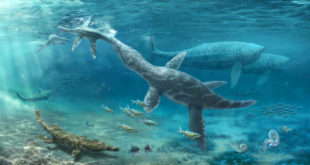
Jurassic deep-water reptiles thrived as sea levels rose, while species that dwelled in the shallows waters disappeared, according to new research from the University of Edinburgh. An artist’s impression of Jurassic marine reptiles. Image credit: Nikolay Zverkov. For more than 18 million years, diverse reptile species lived together in a …
Read More »Vorombe titan: Researchers Name World’s Largest Ever Bird
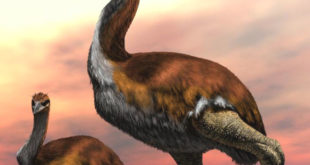
After decades of conflicting evidence and numerous publications, a team of researchers at the Zoological Society of London’s Institute of Zoology has finally put the ‘world’s largest bird’ debate to rest. An artist’s illustration of a giant elephant bird. Image credit: Jaime Chirinos. Elephant birds are members of the extinct …
Read More »New Species of Prehistoric Short-Tailed Bird Found in China
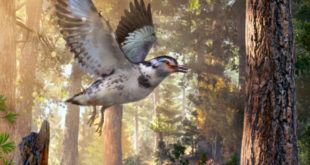
Paleontologists have found the remains — the well-preserved complete skeleton and feathers — of a short-tailed bird that lived 127 million years ago (Early Cretaceous epoch) in northeastern China. Jinguofortis perplexus. Image credit: Chung-Tat Cheung. The ancient bird, dubbed Jinguofortis perplexus, had a body mass of 250 g, a wing …
Read More »Ancient Cholesterol Confirms Dickinsonia as One of Earth’s First Animals
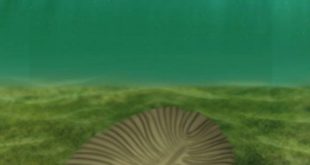
The first complex organisms emerged during the Ediacaran period (635-541 million years ago). Ediacaran fossils are as ‘strange as life on another planet’ and have evaded taxonomic classification, with interpretations ranging from marine animals or giant single-celled protists to lichens. Fossils of one of these creatures — a flat, oval-shaped …
Read More »Large Angiosperm Trees Grew in North America 15 Million Years Earlier than Thought
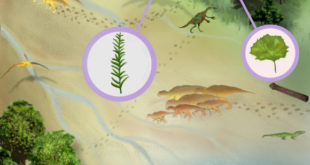
According to new research led by Dr. Nathan Jud of William Jewell College, angiosperm (also called broad-leaf, hardwood or deciduous) trees approaching 6.5 feet (2 m) in diameter were part of the forest canopies across southern North America by the Turonian stage of the Late Cretaceous epoch, approximately 92 million …
Read More »