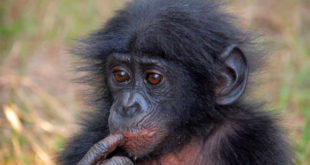
Great apes of all species — human and non-human — communicate using a combination of different types of signals: vocalizations, gestures, facial expressions and body postures. According to a new study, published in the journal Animal Cognition, one- to two-year-old human children use many of the gestures observed in great …
Read More »Common Herbicide Glyphosate Alters Bee Gut Microbiota, Increases Susceptibility to Infections
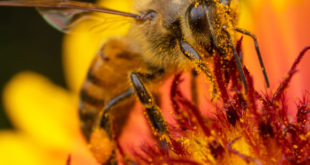
A new study published in the Proceedings of the National Academy of Sciences shows that honeybees exposed to glyphosate — the primary herbicide used globally for weed control — lose some of the beneficial gut bacteria and are more susceptible to infection by opportunistic pathogens. A honeybee. Image credit: Alex …
Read More »Praying Mantis Spotted Hunting and Eating Fish for the First Time
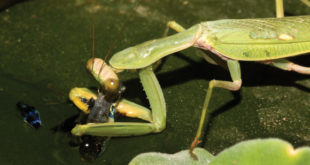
Praying mantises are carnivorous insects with powerful raptorial front legs. Their diet includes insects, lizards, frogs, newts, mice, small birds, snakes and turtles. A new study, published in the Journal of Orthoptera Research, adds fish to their menu. Hierodula tenuidentata eating Poecilia reticulata from the tail. Image credit: Rajesh Puttaswamaiah. …
Read More »Intestinal Bacteria Can Generate Electric Current, Study Shows
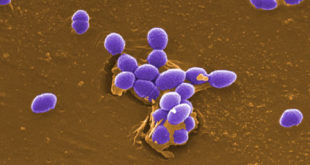
Scientists already know that bacteria can create an electric current outside their own cell, known as extracellular electron transport. This has been demonstrated and analyzed in detail in some bacteria that specialize in the metabolism of metal salts. A team of researchers from Lund University and the National University of …
Read More »New Hummingbird Species Discovered in Ecuador
A new species of hummingbird, called the blue-throated hillstar (Oreotrochilus cyanolaemus), has been discovered in the southwestern Andes of Ecuador by an international team of ornithologists. The blue-throated hillstar (Oreotrochilus cyanolaemus), male. Image credit: Sornoza-Molina et al, doi: 10.1642/AUK-18-58.1. Hillstars are hummingbirds of the genus Oreotrochilus. These birds are approximately …
Read More »Scientists Discover New Species of Reef Fish: Tosanoides aphrodite
Marine biologists from the California Academy of Sciences have discovered a new species of coral reef fish living in the waters off Saint Paul’s Rocks, an archipelago of small islets located around 580 miles (940 km) from northeastern Brazil. Tosanoides aphrodite in its natural environment, photographed at a depth of …
Read More »Neurotransmitter Dopamine Makes Harvester Ants More Productive: Study
Colonies of the red harvester ant (Pogonomyrmex barbatus) forage in the desert for seeds that provide both food and water. Foragers lose water while out in the desert Sun, and the rate of water loss is higher in dry conditions. To manage the tradeoff between food accumulation and water loss, …
Read More »Study: Giraffe Calves Inherit Spot Patterns from Mothers
According to a new study, published in the journal PeerJ, some features of a giraffe’s spot pattern are passed on from mother to baby. Newborn giraffes with large and irregularly shaped spots survive better during their first few months of life. Image credit: Derek Lee, Wild Nature Institute / Pennsylvania …
Read More »Extreme Pressures and Temperatures Turn Nitrogen Metallic
New research indicates that nitrogen, one of the most-common elements in the Universe and the dominant gas in the atmosphere of Earth, becomes a metallic fluid when subjected to the extreme pressure and temperature conditions found deep inside the Earth and other planets. Nitrogen is most-commonly bonded with itself in …
Read More »Researchers Move One Step Closer to High-Performance Quantum Computing
A multinational team of researchers led by University of Cambridge scientist Dr. Alessandro Rossi and University of Adelaide’s Dr. Giuseppe Tettamanzi has developed a ground-breaking single-electron ‘pump.’ Their work was published on June 19, 2018 in the journal Nano Letters. Rossi et al operate a hybrid electron pump in silicon …
Read More »