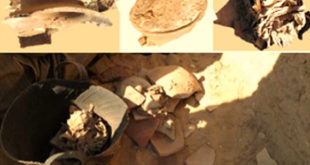
The world’s oldest solid cheese has been found inside the tomb of Ptahmes in Saqqara, part of the necropolis of the ancient Egyptian city of Memphis. Jar and canvas discovered inside the tomb of Ptahmes, Mayor of Memphis during the XIX dynasty. Image credit: Greco et al, doi: 10.1021/acs.analchem.8b02535. Ptahmes …
Read More »500,000-Year-Old Artifacts Reveal Modern Human-Like Gripping Capabilities
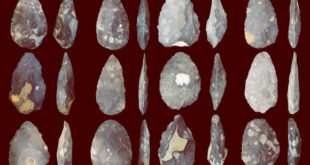
New research published in the journal PeerJ demonstrates that a technique used to produce ‘Late Acheulean’ handaxes is likely to have needed a modern human-like hand. The study, led by University of Kent archaeologist and paleoanthropologist Alastair Key, is the first to link a stone tool production technique known as ‘platform preparation’ …
Read More »Study: Climate Change Contributed to Neanderthal Demise
The transition from Neanderthals to modern humans in Europe occurred during a period of recurring cold climate cycles. In a new study, a team of researchers from Germany, Austria, Romania, the United States and the United Kingdom examined climate records from Carpathian stalagmites covering a period from 44,000 to 40,000 …
Read More »Tools of Ancient Easter Islanders Hint at Sophisticated Society
By analyzing the chemical makeup of toki, tools that were used by Easter Island’s inhabitants to create the giant moai statues, Field Museum researcher Laure Dussubieux and colleagues found evidence of a very complex society where the people shared information and collaborated. Ancient Easter Islanders. Image credit: © Santiago Caruso. …
Read More »Pottery Analysis Reveals Earliest Mediterranean Cheese Production 7,200 Years Ago
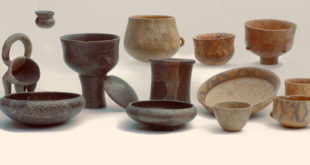
An analysis of fatty residue in pottery from two Neolithic archaeological sites in Croatia has revealed evidence of fermented dairy products (soft cheeses and yogurts) from approximately 7,200 years ago. A suite of Middle Neolithic pottery including a typical Danilo ware, figulina, and rhyton. Image credit: Muzej Grada Šibenika. Access …
Read More »North American Indigenous Peoples Used Turtle Shells as Symbolic Musical Instruments
According to a new study published in the journal PLoS ONE, turtles served as more than tasty treats for Native American tribes throughout North America; in fact, turtle shells were used as rattles and other musical instruments. Four Eastern box turtle rattles tied to leather legging with leather string with …
Read More »Earliest Known Drawing by Human Discovered in South Africa
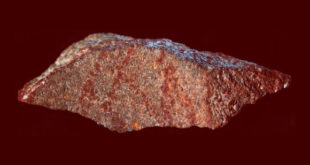
A cross-hatched pattern drawn with an ochre crayon on a small piece of siliceous rock (silcrete) is 73,000 years old. It pre-dates the earliest previously known abstract drawings by at least 30,000 years and demonstrates the ability of early Homo sapiens to produce graphic designs on various media using different …
Read More »13,000-Year-Old Brewery Found in Israel
An international team of researchers from Stanford University and the University of Haifa has found the oldest archaeological evidence of cereal-based beer brewing. The discovery is described in the Journal of Archaeological Science: Reports. (A) the location of Raqefet Cave and three additional Natufian sites in Mt. Carmel, Israel; (B) …
Read More »Ancient Maya Captured and Traded Big Cats: Study
The ancient Maya routinely captured and traded wild jaguars (Panthera onca) and pumas (Puma concolor) for symbolic and ritual purposes, according to an analysis of animal remains from the Maya city of Copan, in present-day Honduras. The jaguar (Panthera onca). Image credit: Marco Verch / CC BY 2.0. Long before …
Read More »Archaeologists Uncover 1,500-Year-Old Maya Altar in Guatemala
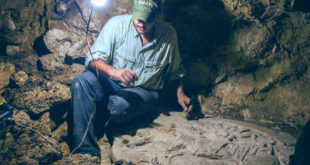
An international group of archaeologists has found a carved limestone altar at the Maya site of La Corona, located in jungle forest of the Petén in Guatemala. Archaeologist Dr. Marcello Canuto sits beside the ancient Maya altar he and his colleagues discovered in the jungles of northern Guatemala. Image credit: …
Read More »