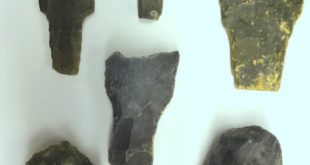
Like the ancient Roman, Asian, and other civilizations, the ancient Maya produced salt and salted fish — storable commodities for marketplace trade, according to a new study published in the Proceedings of the National Academy of Sciences. Stone tools from the Paynes Creek Salt Works, Belize. Image credit: Louisiana State …
Read More »Archaeologists Find Traces of 3,500-Year-Old Nutmeg-Spiced Food
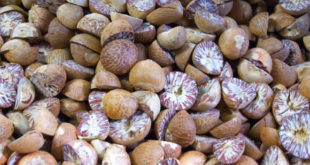
Residue on ceramic potsherds found at an archaeological site on the island of Pulau Ay (Ai), Indonesia, shows the nutmeg (Myristica fragrans) was used as a food ingredient 2,000 years earlier than thought. Lape et al describe the earliest-known use of nutmeg as a food ingredient. Image credit: Quique. The …
Read More »New Sauropod Dinosaur Unveiled: Lingwulong shenqi
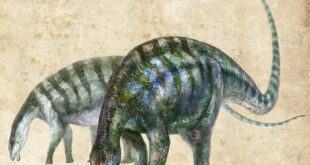
Fossils of a diplodocoid sauropod dinosaur unearthed more than a decade ago in Ningxia Hui Autonomous Region, northwest China, have been recognized as belonging to a new species. An artist’s impression of Lingwulong shenqi. Image credit: Zhang Zongda. Lingwulong shenqi, which lived approximately 174 million years ago (Middle Jurassic epoch), …
Read More »Giant Dinosaur Foot Proclaimed Largest Ever Discovered
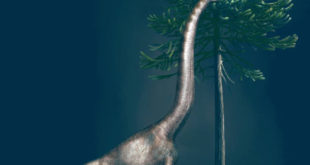
A fossilized dinosaur foot believed to be the largest in the world has been unearthed in Weston County, Wyoming, the United States. This illustration shows a Brachiosaurus eating from an Araucaria tree. These dinosaurs had enormous necks and relatively short tails. The animal to which the foot belongs was nearly …
Read More »Cretaceous Alaska Was ‘Superhighway’ for Migrating Dinosaurs, Paleontologists Say
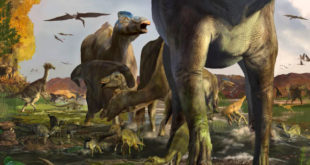
Paleontologists have discovered the first North American co-occurrence of hadrosaur and therizinosaur tracks, providing more evidence that Alaska was the ‘superhighway’ for dinosaurs between Asia and western North America 65-70 million years ago (Late Cretaceous epoch). Life reconstruction of hadrosaur-therizinosaur co-occurrence based on tracks described in this study. Image credit: …
Read More »Research Sheds New Light on How Cave Bears Became Vegetarians
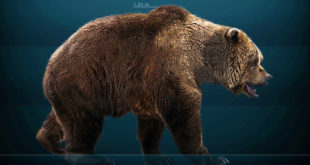
A Middle Pleistocene cave bear, also known as the Deninger’s bear (Ursus deningeri), is generally regarded as the direct ancestor of the mostly vegetarian cave bear (Ursus spelaeus), and the transition between the two species took place around the Middle-Late Pleistocene boundary, about 126,000 years ago. Until now, very little …
Read More »Caelestiventus hanseni: Newly-Discovered Triassic Pterosaur Lived in Harsh Desert
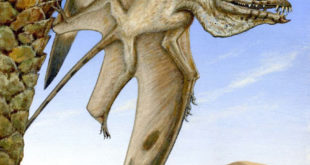
Paleontologists have discovered what they say is a completely unexpected desert-dwelling pterosaur that lived in what is now Utah, the United States, about 210 million years ago. The discovery of this early pterosaur, reported in the journal Nature Ecology and Evolution, sheds new light on early pterosaur anatomy and development. …
Read More »Paleontologists Find Extraordinary Set of Mega-Shark Teeth in Australia
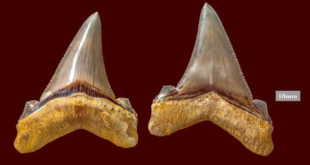
Citizen scientist Philip Mullaly and professional paleontologists have found a very rare set of fossilized shark teeth at Jan Juc, a renowned fossil site along Victoria’s Surf Coast. Carcharocles angustidens teeth. Image credit: Museums Victoria. “I was walking along the beach looking for fossils, turned and saw this shining glint …
Read More »Two New Alvarezsaurian Dinosaurs Unearthed in China
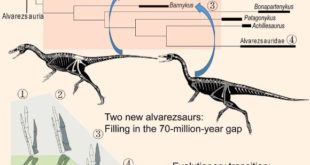
Paleontologists in China have found fossil fragments from two new dinosaur species — named Xiyunykus pengi and Bannykus wulatensis — that walked the Earth approximately 120 million years ago (Cretaceous period). Xu et al report two new Early Cretaceous alvarezsaurian theropods representing transitional stages in alvarezsaurian evolution. The analyses indicate …
Read More »228-Million-Year-Old Fossil Reveals Complex Early History of Turtles
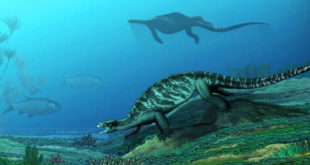
Paleontologists in China have discovered a 228-million-year-old extinct species of turtle, known for its weird disc-like body without a shell and its toothless beak. An artist’s depiction of Eorhynchochelys sinensis as it would have appeared in life 228 million years ago in China. Image credit: Institute of Vertebrate Paleontology and …
Read More »