The first ever evidence of live birth in a group of animals previously thought only to lay eggs has been discovered by an international team of paleontologists from China, the United States, Australia and UK. Artist’s reconstruction of Dinocephalosaurus showing the rough position of the embryo within the mother. Image …
Read More »Proto-Mammals were First Terrestrial Vertebrates to Produce Venom, Paleontologists Say
When you’re a small pre-mammalian creature, sometimes the only way to protect yourself against fearsome predators like saber-toothed carnivores is to turn your saliva into a venomous cocktail. That is exactly what a therocephalian therapsid called Euchambersia mirabilis did about 257 million years ago (Permian period) in what is now …
Read More »Giant Pterosaurs Ruled Late Cretaceous Romania, Says New Study
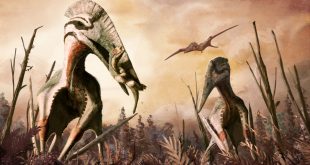
Hatzegopteryx, a flying reptile with a 10-m wingspan and a mass of 220 kg, was the dominant predator in what is now Romania between 72-66 million years ago, according to a study by paleontologists in the UK. Hatzegopteryx, depicted here as a short-necked, powerful predator, consumes the dwarf dinosaur Zalmoxes …
Read More »Fossil Study Rewrites Dinomyidae Family Tree
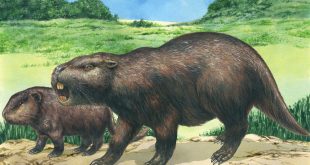
Adult and juvenile fossil specimens of Isostylomys laurdillardi, a giant rodent that lived in South America between 9 and 6.8 million years ago (Miocene epoch), have been found by paleontologists, raising questions about classification within the rodent family Dinomyidae. Isostylomys laurdillardi. Image credit: Andres Rinderknecht et al. Dr. Andres Rinderknecht …
Read More »Meet Websteroprion armstrongi, Ancient Monster Worm with Terrifying Snapping Jaws
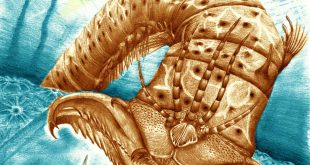
A prehistoric monster worm that terrorized the Devonian seas some 400 million years ago has been identified by an international team of paleontologists from the University of Bristol, Lund University and the Royal Ontario Museum. This is an artistic reconstruction showing Websteroprion armstrongi attacking a fish in the Devonian sea. …
Read More »Ancient Giant Penguin Unearthed in New Zealand
The fossilized leg bones of a giant penguin that lived 61 million years ago have been discovered in New Zealand. Artist’s impression of a group of Waimanu penguins on a beach in Paleocene Canterbury. Image credit: Chris Gaskin, Geology Museum, University of Otago. The fossil was found by amateur fossil …
Read More »World’s Oldest Known Fossils Found in Canada Push Evidence for Life back by 70 Million Years
An international team of paleontologists has discovered in Quebec, Canada, the oldest physical evidence of life on Earth — fossils that date back 3.77 billion years. The discovery was reported online today in the journal Nature. Hematite tubes from the NSB hydrothermal vent deposits that represent the oldest microfossils and …
Read More »105-Million-Year-Old Amber Preserves Pollinating Beetle, Pollen
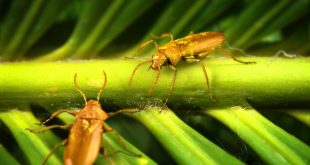
An international team of paleobiologists has uncovered the fossil of a 105-million-year-old gymnosperm pollinating beetle, named Darwinylus marcosi. The fossil, encased in a piece of amber from Spain, is shedding new light on the various ways insects pollinated plants during the mid-Mesozoic era. Reconstruction of Darwinylus marcosi on a gymnosperm …
Read More »Geckolepis megalepis: New Gecko Species Has Exceptionally Large, Fish-Like Scales
A bizarre new species of the fish-scale gecko genus Geckolepis has been found living in the ‘tsingy’ karst formations of northern Madagascar. Geckolepis megalepis in life. Image credit: Frank Glaw. The Geckolepis fish-scale geckos are small- to medium sized arboreal and nocturnal lizards endemic to Madagascar and the Comoro Islands. …
Read More »Scientists Identify Brain-Signaling Molecule that Triggers Fat Burning
A research team led by Scripps Research Institute scientist Dr. Supriya Srinivasan has identified a brain hormone that appears to trigger fat burning in the gut. Model depicting the FLP-7/NPR-22 neuroendocrine axis that underlies the 5-HTergic control of body fat loss. In the nervous system, an integrated 5-HT and octopaminergic …
Read More »