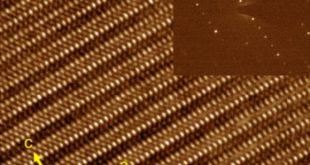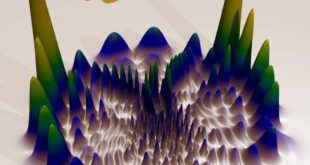
For the first time, physicists have discovered that in an extremely high magnetic field ‘massless’ Dirac electrons can acquire a mass. A false-color high-resolution transmission electron microscopy image of the zirconium pentatelluride (ZrTe5) with an inset selected area electron diffraction (SAED) pattern, showing the layer normal along the b axis. …
Read More »Madala Boson: Physicists Predict Existence of New Heavy Particle
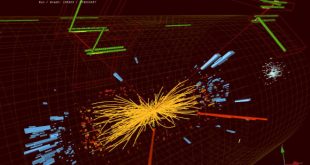
An international team of physicists, led by the University of the Witwatersrand (UW) in Johannesburg, South Africa, predicts the existence of a new particle that might aid in the understanding of dark matter. Proton-proton collisions events in which two high energy electrons and two high energy muons are observed. Image …
Read More »Physicists Visualize Quantum Behavior of High-Energy Electrons
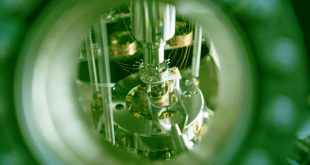
A team of physicists from the University of Birmingham and the University of Bath has identified a method to visualize, over a millionth of a billionth of a second, the initial quantum behavior of electrons on a surface. The scanning tunneling microscope used to inject electrons into a silicon surface. …
Read More »Physicists Demonstrate Existence of Tetraneutron
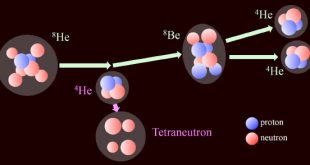
An Iowa State University-led team of physicists has demonstrated the quasi-stable existence of a tetraneutron, a subatomic structure once thought unlikely to exist. Tetra-neutron system produced in double-charge exchange reaction 4He(8He,8Be). Image credit: Susumu Shimoura / University of Tokyo. On their own, neutrons are very unstable and will convert into …
Read More »Physicists Demonstrate Existence of Two States of Liquid Water
There are two states of liquid water, says an international team of physicists led by Oxford University’s Dr. Laura Maestro. L.M. Maestro et al find that two states of liquid water play an important role in the thermal and optical properties of nanomedical systems; the team’s preliminary findings also suggest …
Read More »Physicists Observe Butterfly Rydberg Molecule for First Time
An international team of physicists, led by Prof. Chris Greene from Purdue University and Prof. Herwig Ott from the University of Kaiserslautern, has observed a butterfly Rydberg molecule, a weak pairing of two highly excitable atoms. Their work was published in the Oct. 5 issue of the journal Nature Communications …
Read More »