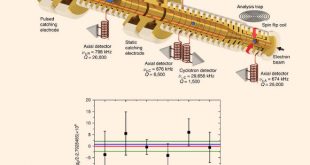
An international team of physicists led by RIKEN researcher Stefan Ulmer has found that the magnetic moment of the antiproton is extremely close to that of the proton, with six-fold higher accuracy than before. Top: schematic of the Penning trap set-up used in CERN’s BASE experiment; a cloud of antiprotons …
Read More »CERN Physicists Observe Light Spectrum of Antimatter for the First Time
Physicists from CERN’s ALPHA experiment today report the first ever measurement on the optical spectrum of an antimatter atom. Artist’s impression of a cloud of trapped antihydrogen atoms. Image credit: Chukman So. “Using a laser to observe a transition in antihydrogen and comparing it to hydrogen to see if they …
Read More »Physicists Give Schrödinger’s Cat Second Box
Through new experiments involving the Schrödinger’s cat state paradox, physicists at Yale University have shown that the famous cat can be in two separate locations at the same time. Chen Wang and co-authors have given Schrödinger’s cat a second box to play in. Image credit: Michael S. Helfenbein / Yale …
Read More »Physicists Identify Second Gravitational-Wave Event
An international team of scientists has identified a second gravitational wave event in the data from the twin detectors of the Laser Interferometer Gravitational-Wave Observatory (LIGO). This image depicts two black holes just moments before they collided and merged with each other, releasing energy in the form of gravitational waves. …
Read More »CERN Physicists Observe Three New Tetraquark Particles
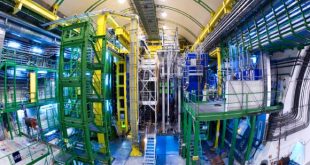
Physicists on CERN’s LHCb collaboration say they’ve observed three new exotic particles – X(4274), X(4500) and X(4700) – and also confirmed the existence of a fourth one, X(4140). According to the scientists, each of these particles contains two quarks and two antiquarks. View of the LHCb detector. Image credit: CERN. …
Read More »Gas Giant Planets May Contain Layers of ‘Dark Hydrogen,’ Say Physicists
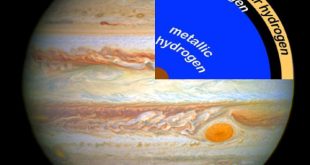
On the surface of giant gaseous planets, hydrogen is a gas. But between this gaseous layer and the liquid metal hydrogen in the planet’s core lies a layer of dark hydrogen, says a team of physicists led by Dr. Alexander Goncharov from Carnegie Institution of Washington and University of Edinburgh …
Read More »Pauli Exclusion: Physicists Directly Observe Key Principle of Quantum Mechanics
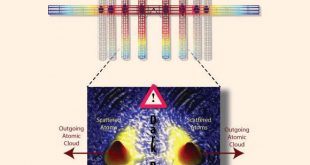
An international team of scientists, led by Dr. Niels Kjærgaard from the University of Otago in Dunedin, New Zealand, has used steerable ‘optical tweezers’ to split ultracold clouds of potassium-40 (40K) atoms and smash them together to directly observe a key principle of quantum mechanics – the Pauli exclusion principle. …
Read More »Physicists Shed New Light on How Neutrinos Behave
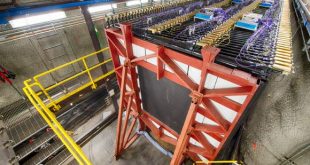
Physicists from the NOvA collaboration have announced a new result that could improve our understanding of the behavior of neutrinos. NOvA detector. Image credit: Louise Suter / NOvA Collaboration. Neutrinos are tiny, nearly massless subatomic particles that travel at near-light speed. They have previously been detected in three types, called …
Read More »Physicists Suggest Light Could Exist in Previously Unknown Form
According to a team of physicists at Imperial College London (ICL), UK, it is possible to create a new form of light by binding light to a single electron, combining the properties of both. Artistic image of light trapped on the surface of a topological insulator. Image credit: Vincenzo Giannini. …
Read More »Theoretical Physicists Confirm Possible Discovery of Nature’s Fifth Fundamental Force
Recent findings by a team of experimental nuclear physicists in Hungary indicating the possible discovery of a new subatomic particle may be evidence of a fifth force of nature, according to a team of theoretical physicists at the University of California, Irvine. The discovery of a possible fifth force of …
Read More »