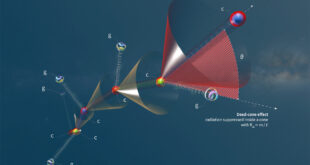
In particle collider experiments, elementary particle interactions with large momentum transfer produce quarks and gluons (known as partons) whose evolution is governed by the strong force, as described by the theory of quantum chromodynamics. These partons subsequently emit further partons in a process that can be described as a parton …
Read More »Triple J-Psi Meson
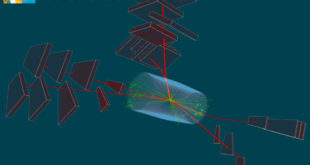
Physicists from the Compact Muon Solenoid (CMS) Collaboration at CERN’s Large Hadron Collider (LHC) have observed three J/ψ particles emerging from a single collision between two protons. A proton-proton collision event with six muons (red lines) produced in the decays of three J/ψ particles. Image credit: CMS / CERN. The …
Read More »Physicists Unprecedented Precision
Physicists have performed an improved measurement of the free neutron lifetime using the UCNτ apparatus at the Los Alamos Neutron Science Center. Their results, published in the journal Physical Review Letters, represent a more than two-fold improvement over previous measurements. Gonzalez et al. report an improved measurement of the free …
Read More »Exotic Indium Nuclei
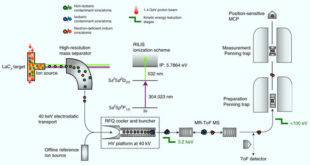
The isotope tin-100 is of interest for nuclear structure due to its closed-shell proton and neutron configurations. It is also the heaviest nucleus comprising protons and neutrons in equal numbers. In new research, physicists from the ISOLTRAP experiment at CERN’s Isotope mass Separator On-Line (ISOLDE) facility performed direct mass measurements …
Read More »Superionic Water’s
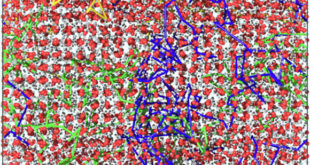
Using machine learning, a team of physicists at Lawrence Livermore National Laboratory has studied the phase behaviors of superionic water — a phase of water where hydrogen atoms become liquid-like while oxygen atoms remain solid-like on a crystalline lattice — with unprecedented resolution. Hydrogen atoms diffuse easily between the superionic …
Read More »CERN Physicists Triple W
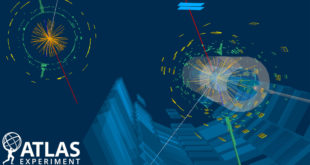
Physicists from the ATLAS Collaboration at CERN’s Large Hadron Collider (LHC) have observed a process called WWW production: the simultaneous creation of three massive W bosons in high-energy proton-proton collisions. Display of a candidate WWW→ 3 leptons + neutrinos event; the event is identified by its decay to a muon …
Read More »Lepton Flavor Universality
Physicists from the ATLAS Collaboration at CERN’s Large Hadron Collider (LHC) have successfully performed measurements of ‘lepton flavor universality,’ a fundamental principle of the Standard Model of particle physics. Their results are the first such measurement from LHC, and the most precise one to date, surpassing the precision obtained from …
Read More »Quark-Gluon Plasma
Quark-gluon plasma is a state of dense matter with the quarks and gluons being its constituents. Soon after the Big Bang the matter was just in such a phase. When the Universe was expanding and cooling down the quark-gluon plasma turned into hadrons (neutrons and protons), which further formed the …
Read More »New Uranium Isotope
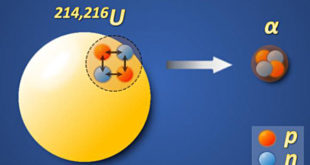
Physicists at the Heavy Ion Research Facility in China have observed the lightest uranium isotope to date, uranium-214 (214U), and precisely measured the α-decay properties of two previously known isotopes, 216U and 218U. Enhanced α-particle preformation in 214U and 216U. Image credit: Zhang et al., doi: 10.1103/PhysRevLett.126.152502. Uranium is a …
Read More »Physicists Active Matter
Named a swirlonic state, the newly-discovered state of active matter is comprised of swirlons, formed by groups of active quasiparticles orbiting their common center of mass. Swirlons demonstrate a surprising behavior: in response to an external load they move with a constant velocity proportional to the applied force, just as …
Read More »