A microscopic, bag-like marine creature that lived approximately 540 million years ago (Fortunian stage of the Cambrian period) has been identified from microfossils found in Shaanxi Province, China. Reconstruction of Saccorhytus coronaries: lateral, hind and ventral views. Image credit: Jian Han et al, doi: 10.1038/nature21072. The ancient animal, named Saccorhytus …
Read More »Explosions used to make large quantities of graphene
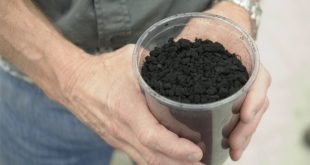
Graphene was discovered in 2004, and right away its remarkable mechanical and electrical properties made it a hot topic of research. Graphene could be used for super-efficient batteries, solar panels, and much more. But after 13 years, we still don’t have any of that. The problem is that graphene is …
Read More »Saturn’s Main Rings Up Close
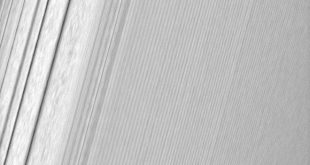
NASA’s Cassini spacecraft took these stunning photos of Saturn’s rings on December 18, 2016, while it was performing one of its ‘ring-grazing’ orbits. This Cassini image features a density wave in Saturn’s A ring (at left) that lies around 83,575 miles (134,500 km) from Saturn. Density waves are accumulations of …
Read More »Optical shock: Scientists have imaged light going faster than itself
A team of researchers at Washington University in St. Louis has taken images of a laser pulse generating an optical Mach cone: the equivalent of a sonic boom, but for light. To make an optical Mach cone, a pulse of light would need to be traveling faster than the waves …
Read More »38,000-Year-Old Aurignacian Artwork Found in France
Researchers have uncovered a 38,000-year-old engraved image at Abri Blanchard, an Upper Paleolithic site of the Aurignacian culture — a finding that marks some of the earliest known graphic imagery found in Western Eurasia. Limestone block engraved with an aurochs. Image credit: P. Jugie, Musée National de Préhistoire Collections. The …
Read More »Physicists Produce World’s First Sample of Metallic Hydrogen
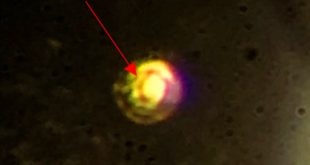
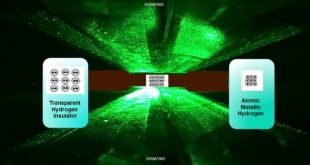
A duo of physicists at Harvard University has succeeded in creating a metallic modification of hydrogen. The research is published in the journal Science. Photo of metallic hydrogen at a pressure of 495 GPa; the sample is non-transmitting and is observed in reflected light; the central region is clearly more …
Read More »Sleep Deprivation Suppresses Your Immune System, Study of Twins Shows
A University of Washington-led team of researchers studying monozygotic (identical) twins has found that chronic sleep deprivation suppresses immune system. The research is published in the journal Sleep. The study by N.F. Watson et al shows the transcriptomic effects of habitual short sleep on dysregulated immune response and provides a …
Read More »Juno Sees Massive Storm on Jupiter
NASA’s Juno spacecraft has spotted a huge anticyclonic storm in Jupiter’s high north temperate latitudes. Juno snapped this shot of Jupiter’s northern latitudes on Dec. 11, 2016, as the orbiter performed a close flyby of the gas giant. The spacecraft was at an altitude of 10,300 miles (16,600 km) above …
Read More »Researchers claim they compressed hydrogen into a metallic state
Researchers have been chasing the dream of metallic hydrogen for decades, ever since the material was first theorized by Princeton University scientists Eugene Wigner and Hillard Bell Huntington in 1935. If it exists, metallic hydrogen could fundamentally transform the way we used energy. Now, two scientists claim they’ve successfully created …
Read More »Physicists Unveil ‘Time Crystals’
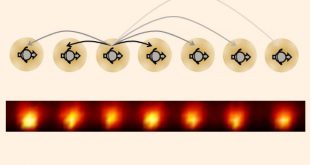
Thanks to a breakthrough by a research team led by University of California Berkeley physicist Norman Yao, time crystals are now a reality. Following a blueprint created by N.Y. Yao et al, University of Maryland physicists made the first time crystal using a one-dimensional chain of ytterbium ions; each ion …
Read More »