During asteroid search operations, NASA’s OSIRIS-REx spacecraft snapped several images of Jupiter and its Galilean moons: Io, Europa, Callisto, and Ganymede. This composite image showing Jupiter (center) and three of its moons — Callisto (left), Io, and Ganymede — was taken by OSIRIS-REx’s PolyCam instrument. Image credit: NASA / Goddard …
Read More »ESA Releases Stunning Mosaic of Mars’ North Pole
Researchers, using a camera aboard ESA’s Mars Express, have created a stunning mosaic of Mars’ north polar region. Perspective view of Mars’ north polar ice cap and its distinctive dark troughs forming a spiral-like pattern. The view is based on images taken by ESA’s Mars Express and generated using elevation …
Read More »Cassini Captures Close-Up View of Saturn’s Intriguing F Ring
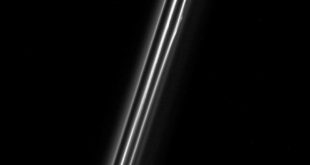
When seen up close, Saturn’s F ring — the outermost discrete ring of the gas giant — resolves into multiple dusty strands. This Cassini view shows four dusty strands of Saturn’s F ring: the central strand is the core of the ring; the other strands are not independent at all, …
Read More »NASA revamps site for EPIC photos of Earth from space
There are a myriad of satellites in orbit of Earth with cameras that can send back amazing photos, but they can’t snap a photo of the entire planet at once. NASA’s Earth Polychromatic Imaging Camera (EPIC) camera can, though. It sends back thousands of amazing photos every year, and now …
Read More »Ordovician Fossil Sheds New Light on Early Evolution of Mollusks
Paleontologists have unearthed the remains of a previously unknown slug-like creature that lived during the Early Ordovician epoch, 478 million years ago. The discovery, reported in the journal Nature, sheds new light on the earliest stages in the evolution of mollusks, a group of invertebrates that includes clams, snails and …
Read More »Cheirogaleus shethi: New Species of Dwarf Lemur Found in Madagascar
A new dwarf lemur species has been discovered in the dry and transitional forests of northern Madagascar, according to a paper published in the latest issue of the journal Primate Conservation. The Sheth’s dwarf lemur (Cheirogaleus shethi) at Ankarana Special Reserve, Madagascar. Image credit: Richard Randriamampionona. Dwarf lemurs (genus Cheirogaleus) …
Read More »Juno Completes Its Fourth Flyby of Jupiter
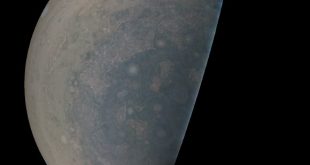
NASA’s Juno spacecraft successfully completed a close flyby of Jupiter on February 2, 2017. Cyclones swirl around the south pole, and white oval storms can be seen near the limb — the apparent edge of the planet — in this image of Jupiter’s south polar region taken by the JunoCam …
Read More »Problems with SpaceX Falcon 9 design could delay manned missions
SpaceX is no stranger to delays. The private space firm headed by Elon Musk has pushed back is launch schedule several times in the last few years after rockets have been lost. Now, the Government Accountability Office (GAO) says there may be an issue with the Falcon 9 rocket that …
Read More »Critically Endangered Dryas Monkeys Caught on Video
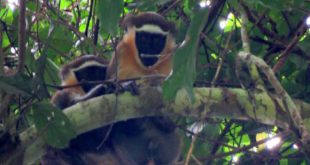
Using camera traps, primatologists from the Lukuru Foundation Tshuapa-Lomani-Lualaba (TL2) Project are the first to capture video footage of a previously unknown population of the critically endangered Dryas monkey (Cercopithecus dryas). Close-up of critically endangered Dryas monkeys (Cercopithecus dryas) now inhabiting the Lomami National Park in the Democratic Republic of …
Read More »Scientists devise tiny spacecraft with giant light sails to visit nearest exoplanet
Astronomers announced several months ago that there is most likely a small Earth-like planet in orbit of Proxima Centauri. That’s a big deal because Proxima Centauri happens to be the closest star to Earth, at just a bit over four light years away. That’s still an insurmountable distance for human …
Read More »