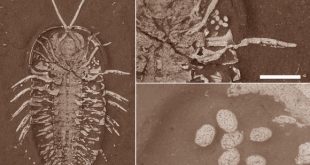
A research team led by Western Illinois University scientist Thomas Hegna has announced the discovery of two pyritized, egg-bearing specimens of the Ordovician trilobite Triarthrus eatoni. Left: ventrally preserved specimen of the Ordovician trilobite Triarthrus eatoni showing nine eggs in the specimen’s left genal angle; scale bar – 5 mm. …
Read More »Private space firm wants to reuse parts of the International Space Station
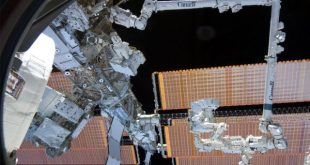
The International Space Station (ISS) was first launched in 1998, but it took a number of years and multiple launches to get all the pieces in place. The station currently houses a crew of six, and will continue to do so for a few more years. The ISS will be …
Read More »Astronomers may have figured out why alien planets lack exomoons
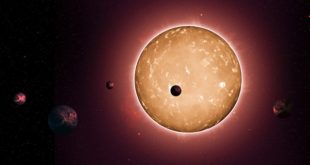
Astronomers have found a great many exoplanets out there among the stars, but one thing they have not found is exomoons. There’s no evidence of moons orbiting any of the planets we’ve found orbiting other stars, and it’s not clear why. Moons are obviously common in our solar system — …
Read More »King Solomon-Era Fortification Unearthed in Israel’s Timna Valley
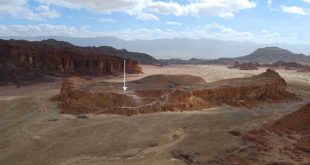
A team of Tel Aviv University archaeologists has uncovered a gatehouse and associated livestock pens — dating to the reign of Kings Solomon and David (10th century BC) — at the Slaves’ Hill, one of the largest copper smelting camps in Timna Valley, Israel. The team’s research appears in the Journal …
Read More »Mid-Cretaceous Burmese Amber Preserves Alien-Looking Insect
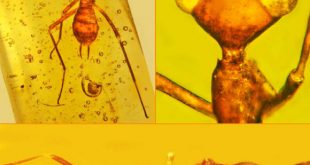
In a paper published in the journal Cretaceous Research, Oregon State University researchers described a never-before-seen insect species found in a piece of 100-million-year-old amber excavated from a mine in Myanmar (previously known as Burma). Aethiocarenus burmanicus in mid-Cretaceous Burmese amber. The specimen originated from the Noije Bum 2001 Summit …
Read More »Cassini’s New Breathtaking Image of Tethys
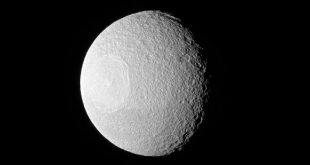
NASA’s Cassini spacecraft has sent back a breathtaking image of Tethys, a small, icy moon of Saturn. Cassini’s narrow-angle camera took this image of Tethys on November 10, 2016. The view was acquired at a distance of approximately 228,000 miles (367,000 km) from Tethys. Image credit: NASA / JPL-Caltech / …
Read More »Debris from ancient asteroid explosion still peppering our planet
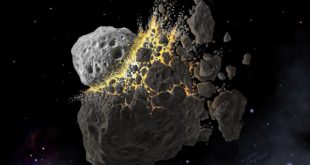
At a time when terrestrial plant life was just beginning to take hold here on Earth some 466 million years ago, a massive asteroid collision happened someplace nearby. We don’t know much about the nature of the original objects that collided, except that one of them was about the size …
Read More »Stable Semi-Synthetic Bacterium Created
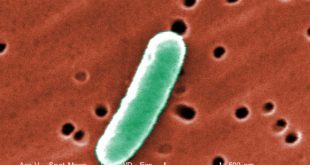
Researchers from the United States, China and France have created what they say is the world’s first stable semi-synthetic microorganism. The research appears in the Proceedings of the National Academy of Sciences. At an extremely high magnification of 44,818x, this colorized scanning electron microscopic (SEM) image reveals some of the …
Read More »Methane Gas May Have Caused Greenhouse Effect on Young Mars, Planetary Researchers Say
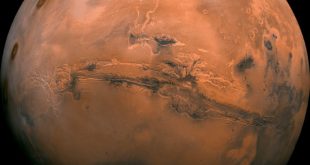
Methane present in the early Martian atmosphere, together with carbon dioxide and hydrogen may have created a greenhouse effect on the planet 3.5-4.5 billion years ago, according to a Harvard University-led team of researchers. Mosaic of the Valles Marineris hemisphere of Mars projected into point perspective, a view similar to …
Read More »Study: Today’s Rare Meteorites Were Common in Ordovician Period
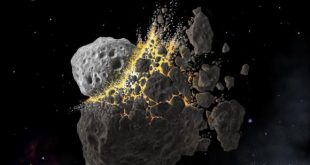
A new study published in the journal Nature Astronomy is the first to look at meteorites from before giant space collision 466 million years ago. This is an artist’s rendering of the space collision 466 million years ago that gave rise to many of the meteorites falling today. Image credit: …
Read More »