According to a new study published in the journal PLoS Genetics, dwindling populations created a ‘mutational meltdown’ in the genomes of the last wooly mammoths, which had survived on Wrangel Island in the Arctic Ocean until about 3,700 years ago. This is an artist’s rendition of a woolly mammoth. Image …
Read More »The Secrets of Pluto’s Thin Blue Line
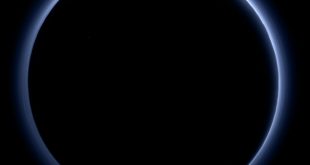
“Like a summer’s evening here on Earth just after sunset. A faint blue glow follows the Sun below the horizon — the only bit of color within an otherwise black sky,” Tanguy Bertrand imagines a view from the surface of Pluto, a picture more fully realized following recent man-made visitors …
Read More »Researchers Measure Brightness, Temperatures of Saturn’s Main Rings
Using mid-infrared data from the 8.2-m Subaru Telescope, a research team led by Dr. Hideaki Fujiwara, Subaru scientist at the National Astronomical Observatory of Japan, has measured the brightness and temperatures of Saturn’s main rings. This is a three-color composite image of Saturn and its rings taken January 23, 2008 …
Read More »‘Molecular Switch’ that Causes Mucosal Autoimmune Diseases Discovered
According to an international team of researchers led by University College London and King’s College London, the discovery of a ‘molecular switch’ that causes the mucosal inflammatory diseases ulcerative colitis, Crohn’s disease, and celiac disease, could lead to effective new treatments for these autoimmune conditions. The discovery is reported in …
Read More »Cassini Captures Stunning View of Enceladus
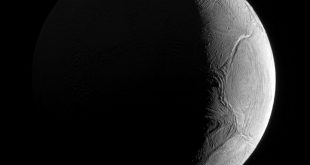
NASA has released a new image of Enceladus, the sixth-largest of Saturn’s moons, taken by the agency’s Cassini orbiter. NASA’s Cassini robotic orbiter obtained this image of Saturn’s moon Enceladus on November 27, 2016. This view looks toward the Saturn-facing hemisphere of the moon. North on Enceladus is up and …
Read More »Did Ancient Martian Volcanism Provide the Sunblock to Get Life Going?
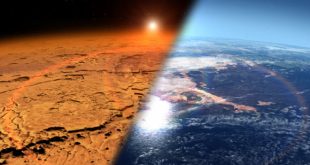
Intense volcanism early in Mars history could have aided the emergence of life on the red planet through filtering out harmful ultraviolet (UV) radiation whilst allowing helpful longer wavelength UV to power vital prebiotic chemistry. These are the possibilities raised by a Harvard University study assessing the potential influence of …
Read More »Science Report on NASA’s Europa Lander Concept Released
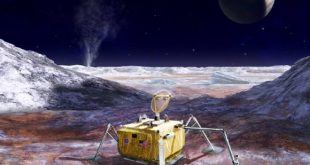
In a new report to NASA released this week, a 21-member team of scientists assess the scientific value and engineering design of a future mission to the surface of Europa. This artist’s rendering illustrates a conceptual design for a potential future mission to land a robotic probe on the surface …
Read More »Cassini Orbiter Zooms Past Two Saturnian Moons: Epimetheus and Mimas
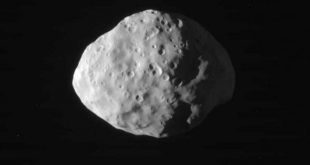
NASA’s Cassini robotic orbiter captured these images of Mimas and Epimetheus during a close flyby on January 30, 2017. This image of Saturn’s moon Epimetheus was taken on January 30, 2017 and received on Earth February 1, 2017. The image was taken using the CL1 and GRN filters. Image credit: …
Read More »Researchers Uncover New Evidence for Water on Ancient Mars
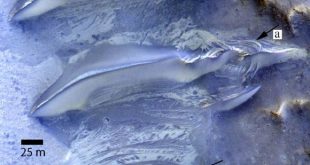
Dr. Mary Bourke from Trinity College Dublin and University of Oxford Professor Heather Viles have discovered a patch of land in an equatorial crater on Mars that appears to have been flooded by large volumes of water in the planet’s past. A large pit valley in Lucaya crater, Mars: (a) …
Read More »Aliphatic Organic Compounds Detected on Ceres
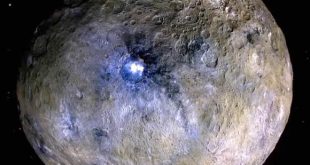
An international team of planetary researchers has discovered the presence of aliphatic organic compounds — carbon-based building blocks that may have a role in the chemistry that creates life — on Ceres, the largest object in the main asteroid belt. And, according to the team, the organics are most likely …
Read More »