
The tail of bipedal non-avian dinosaurs played a role analogous to the swinging arms of humans during walking and running, according to new research led by Harvard University’s Dr. Peter Bishop.
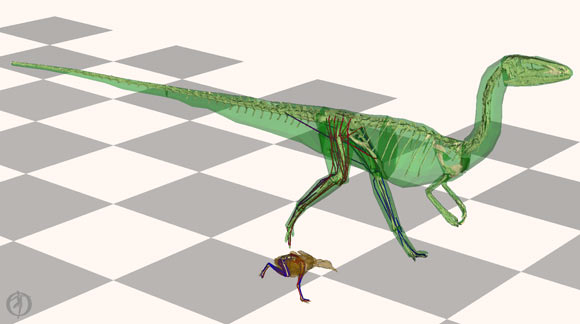
Computer simulations of running locomotion in a modern tinamou bird (brown) and the extinct theropod dinosaur Coelophysis (green). Gray tiles – 50 cm. Image credit: Bishop et al., doi: 10.1126/sciadv.abi7348.
“Previous studies have always treated non-avian dinosaur tails as a static rear extension of the pelvis that acted as a counterbalance,” Dr. Bishop said.
“Essentially, our findings show that dinosaurs like Tyrannosaurus rex and Velociraptor wagged their tails from side to side when they ran, which helped them stay balanced.”
“When I first saw the simulation results I was very surprised, but after running a range of further simulations making the tails heavier, lighter and even no tail at all, we were able to conclusively demonstrate that the tail wagging was a means of controlling angular momentum throughout their gait.”
In the study, Dr. Bishop and colleagues performed computer simulations of running locomotion in the tinamou (Eudromia elegans), a living analog for non-avian theropods.
The three-dimensional, muscle-driven simulations accurately replicated movements in the bird.
The authors then applied their validated framework to a previously developed musculoskeletal model of Coelophysis, a bipedal non-avian theropod dinosaur that lived during the Triassic period, some 210 million years ago.
“We focused on a striding, parasagittal, obligate biped with a pronograde trunk and a long, heavy tail — a body plan that died out 66 million years ago,” they said.
“Unexpectedly, our Coelophysis running simulation involved marked tail lateroflexion that was coupled with hindlimb protraction-retraction.”
The study moves beyond speculation of the tail’s importance, and mechanically demonstrates a previously unrecognized, crucial and 3D dynamic role.
“These cutting-edge, three-dimensional simulations show that we’ve still got much to learn about dinosaurs,” said Professor John Hutchinson, a researcher at the Royal Veterinary College.
“Our results raise interesting questions about how dinosaur tails were used in a whole array of behaviors, not just including locomotion, and how these functions evolved.”
The findings were published in the journal Science Advances.
_____
Peter J. Bishop et al. 2021. Predictive simulations of running gait reveal a critical dynamic role for the tail in bipedal dinosaur locomotion. Science Advances 7 (39); doi: 10.1126/sciadv.abi7348