The newly-discovered dinosaur species, Spicomellus afer, is the earliest-known ankylosaur and the first ankylosaur to be named from Africa. Life reconstruction of the armored dinosaur Borealopelta markmitchelli, which lived in what is now Alberta, Canada, some 110 million years ago, eating ferns. Image credit: Julius Csotonyi / Royal Tyrrell Museum. …
Read More »World’s Earliest Coin Mint
Archaeologists have uncovered 2,640- to 2,550-year-old clay moulds for casting spade coins as well as fragments of finished spade coins at Guanzhuang in Xingyang, Henan province, China. The technical characteristics of the moulds demonstrate that the site — which was part of the Eastern Zhou period (770-220 BCE) bronze foundry …
Read More »Earth’s Earliest Lifeforms
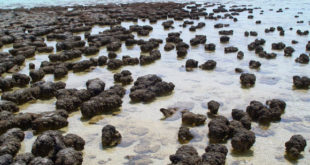
Viruses may be the missing piece of the puzzle that could help explain how soft microbial mats transition into hard stromatolites that are prevalent in such places as Shark Bay and the Pilbara in Australia. Stromatolites at Shark Bay, Western Australia. Image credit: Paul Harrison / CC BY-SA 3.0. Stromatolites …
Read More »Soft Dinosaurs Eggs
Eggs of Earliest Dinosaurs Had Soft, Leathery Shells A team of paleontologists from the United States, Canada and Argentina has analyzed the fossilized eggs of two different non-avian dinosaurs, Protoceratops and Mussaurus, and found that the eggs resembled those of turtles in their microstructure, composition, and mechanical properties. They’ve also …
Read More »Reindeer Domestication
Earliest Evidence of Reindeer Domestication Found in Arctic Siberia An international team of archeologists has unearthed numerous L-shaped barbed antler objects at three early sites — Ust’-Polui, Tiutei-Sale I, and Iarte VI — in the Yamal region of Arctic Siberia. With help from contemporary Indigenous Nenets reindeer herders, the researchers …
Read More »Earliest Signs of Microbial Life on Land Found in 3.48-Billion-Year-Old Hot Spring Deposits
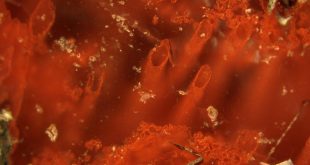
Fossil evidence of early microbial life has been found in ancient hot spring deposits in the Dresser Formation in the Pilbara Craton, Western Australia, that date back approximately 3.48 billion years. A paper reporting this discovery is published in the journal Nature Communications. Spherical bubbles preserved in 3.48 billion-year-old hot …
Read More »Newly discovered rock formations could be fossils from earliest living organisms
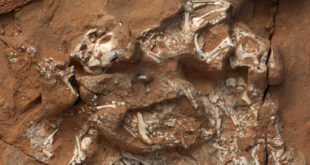
Earth came into being roughly 4.5 billion years ago, and a new discovery in Canada indicates life developed not long after. Scientists studying ancient rock formations in Quebec have identified microscopic structures in the rock that they believe are the fossilized remains of microorganisms that lived on Earth between 3.7 …
Read More »Meet Saccorhytus coronarius, Humans’ Earliest-Known Ancestor
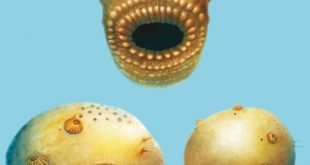
A microscopic, bag-like marine creature that lived approximately 540 million years ago (Fortunian stage of the Cambrian period) has been identified from microfossils found in Shaanxi Province, China. Reconstruction of Saccorhytus coronaries: lateral, hind and ventral views. Image credit: Jian Han et al, doi: 10.1038/nature21072. The ancient animal, named Saccorhytus …
Read More »Nan Madol: Archaeologists Uncover Earliest Evidence of Chiefdom in Pacific
Nan Madol, an ancient administrative and the former capital of the Micronesian island of Pohnpei, was the earliest among the Pacific islands to be ruled by a single chief, according to an international team of archaeologists. Nan Madol ruins on the island of Pohnpei. Image credit: C.T. Snow / CC …
Read More »