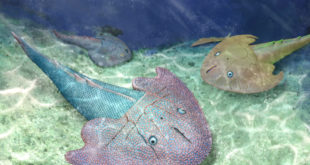
Paleoichthyologists in China have re-described Nochelaspis maeandrine, a species of large-sized eugaleaspiform fish that lived 415 million years ago (Devonian period). Life restoration of Nochelaspis maeandrine. Image credit: Dinghua Yang. Nochelaspis maeandrine was first described in 1987 from a nearly complete head shield found in the Xishancun Formation near Qujing …
Read More »Phacopid Trilobites
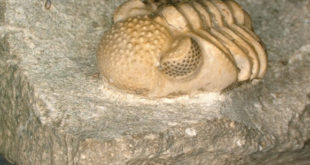
Trilobites are extinct arthropods that dominated the faunas of the Paleozoic Era. Since their appearance 523 million years ago, they were equipped with elaborate compound eyes. While most of them possessed apposition compound eyes, comparable to the compound eyes of many crustaceans and insects living today, trilobites of the suborder …
Read More »Devonian Period Shark
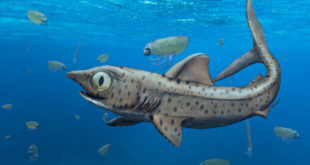
Paleontologists in Morocco have found fossil fragments from a previously undescribed genus and species of symmoriiform shark that lived during the Late Devonian epoch. Ferromirum oukherbouchi reconstructed in association with invertebrates (orthocerid cephalopods and thylacocephalans) from the Devonian of Maider region, Morocco. Image credit: Frey et al., doi: 10.1038/s42003-020-01394-2. The …
Read More »Devonian Jawless Fish
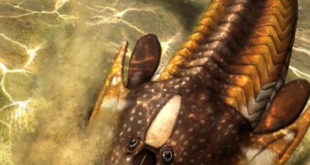
Osteostraci, the jawless sister group to all jawed vertebrates, had adaptations for passive control of water flow around the body, according to new research led by the University of Bristol. Life restoration of Cephalaspis, a typical osteostracan, swimming over the substrate. Image credit: Hugo Salais, Metazoa Studio. Osteostraci (osteostracans) is …
Read More »Devonian Fossil Study
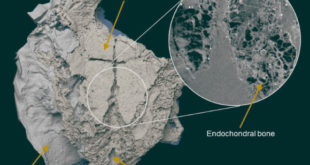
Paleontologists in Mongolia have found the fossilized remains of Minjinia turgenensis, a new genus and species of placoderm fish that lived 410 million years ago (Early Devonian epoch). They’ve examined a partial braincase and skull roof of Minjinia turgenensis and found extensive endochondral bone, the hard bone that makes up …
Read More »Nearby Supernovae
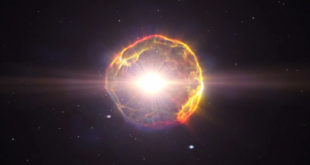
Multiple supernova explosions about 65 light-years away may have contributed to the ozone depletion and several subsequent extinction events at the Devonian-Carboniferous boundary, approximately 359 million years ago, according to a new paper published in the Proceedings of the National Academy of Sciences. An artist’s rendition of a supernova explosion. …
Read More »