Tag Archives: ceres

Almahata Sitta

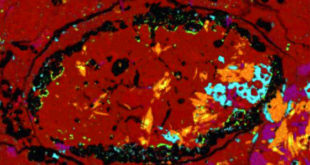
The parent body of the Almahata Sitta meteorites — space rocks that rained down on the Nubian Desert in Sudan in 2008 — is a 640 to 1,800 km-wide water-rich asteroid that is as yet unknown, according to new research. Hamilton et al. studied the composition of Almahata Sitta 202 …

Read More »

Water Rich World

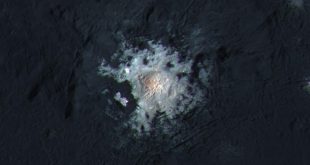
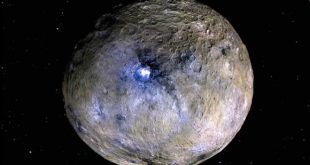
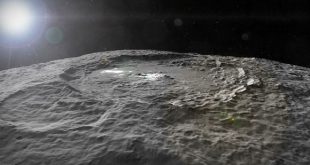
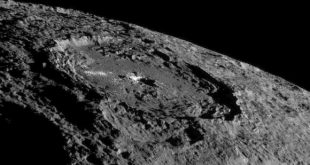
High-resolution observations from NASA’s Dawn spacecraft of mysterious bright spots (faculae) in Occator crater on the dwarf planet Ceres suggest the existence of a brine reservoir — which is about 40 km (25 miles) deep and hundreds of km wide — that emerged to the surface through long-lived cryovolcanic activity …

Read More »

Researchers Determine Age of Ceres’ Brightest Spot

Cerealia Facula, a dome-like feature located in the center of Ceres’ Occator crater, is only 4 million years old — approximately 30 million years younger than the crater itself, according to research led by Dr. Andreas Nathues of the Max Planck Institute for Solar System Research. Cerealia Facula, a bright …

Read More »

Aliphatic Organic Compounds Detected on Ceres

An international team of planetary researchers has discovered the presence of aliphatic organic compounds — carbon-based building blocks that may have a role in the chemistry that creates life — on Ceres, the largest object in the main asteroid belt. And, according to the team, the organics are most likely …

Read More »

Ceres May Have Vanishing Cryovolcanoes

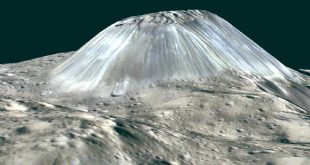
Ahuna Mons, a 2.5-mile- (4 km) tall mountain on Ceres interpreted as a geologically young cryovolcano, may have some hidden older siblings, according to a team of planetary researchers led by Dr. Michael Sori of the University of Arizona. Ahuna Mons, Ceres’ lonely mountain, is seen in this simulated perspective …

Read More »

Dawn Finds New Evidence for Water Ice on Ceres

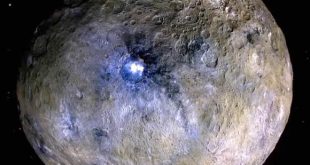
Images from NASA’s Dawn probe have revealed a dark, cratered world whose brightest area is made of reflective salts — not water ice. But several new studies show distinct lines of evidence for ice at or near Ceres’ surface. This false-color image shows the dwarf planet Ceres. Image credit: NASA / …

Read More »
Bizwhiznetwork Consultation