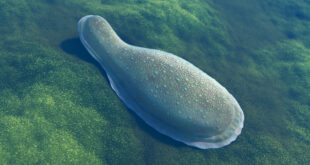
The oldest animals appear in the fossil record among Ediacaran biota communities. In new research, paleontologists from the Australian National University and elsewhere examined the gut contents of three Ediacaran species — the 558-million-year-old tube worm-like Calyptrina and the mollusk-like Kimberella as well as one of the key Ediacaran animals, …
Read More »Non-Photosynthetic Bacteria
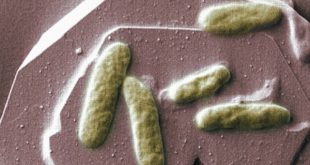
A team of researchers from Germany, Denmark and the United Kingdom has identified circadian rhythms in non-photosynthetic, Gram-positive bacterium Bacillus subtilis. Bacillus subtilis. Image credit: Ákos Kovács, Technical University of Denmark. Circadian rhythms are exquisite internal timing mechanisms that are widespread across nature enabling living organisms to cope with the …
Read More »Gut Bacteria ‘Speak’ to Brain to Control Food Choices in Animals
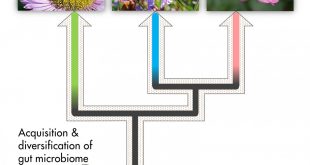
In a study published recently in the journal PLOS Biology, neuroscientists identified three gut bacteria species — Acetobacter pomorum, Lactobacillus plantarum and L. brevis — that have an impact on animal dietary decisions. According to Leitao-Goncalves et al, gut bacteria control food choice and egg laying in Drosophila melanogaster. Image …
Read More »Social Bees Have Kept Symbiotic Gut Bacteria for 80M Years, New Study Says
About 80 million years ago (Cretaceous period), a group of bees began exhibiting social behavior. Today, their descendants — honey bees, stingless bees, and bumble bees — carry ‘stowaways’ from their ancient ancestors. The stingless bee Trigonisca ameliae in Colombian copal. Image credit: Dr David Penney / University of Manchester. …
Read More »Researchers create a tiny tractor beam that totes bacteria around
One of the problems with imaging living biological cells is that they don’t want to be held still. Or, more accurately, they don’t want to be held to a surface like a microscope slide. Prepping and fixing the cells changes them irrevocably, altering whatever a scientist was trying to observe. …
Read More »Multi-Drug Resistant Bacteria Found Deep in New Mexico’s Lechuguilla Cave
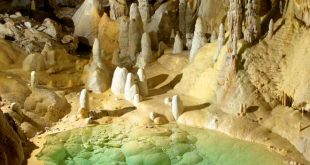
According to a team of researchers led by Gerald Wright, a professor of biochemistry and biomedical sciences at McMaster University, Lechuguilla Cave — an underground ecosystem that has been isolated from the surface for over 4 million years — is home to a remarkable prevalence of antibiotic-resistant bacteria. Lechuguilla Cave, …
Read More »Drug-resistant bacteria tricked into dropping their shields become vulnerable once again
Bait-and-switch might just be the oldest trick in the book, but maybe it’s time to start kickin’ it old school. At least a little bit. In search of another way to manage the endless slog against antibiotic-resistant bacteria, scientists just figured out how to bait bacteria into developing an Achilles’ …
Read More »Deep-dwelling bacteria could rewrite our understanding of where alien life could take hold
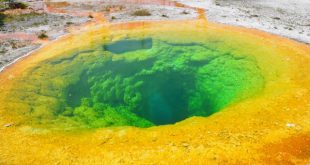
Finding bacteria in extreme environments, like at thermal ocean vents or in the sulfur pools at Yellowstone, isn’t all that novel. In 1991, remote-control robots brought out samples of pitch-black fungi that had been growing inside the ruins of the Chernobyl reactor. Scientists sat up and paid attention, but then …
Read More »