
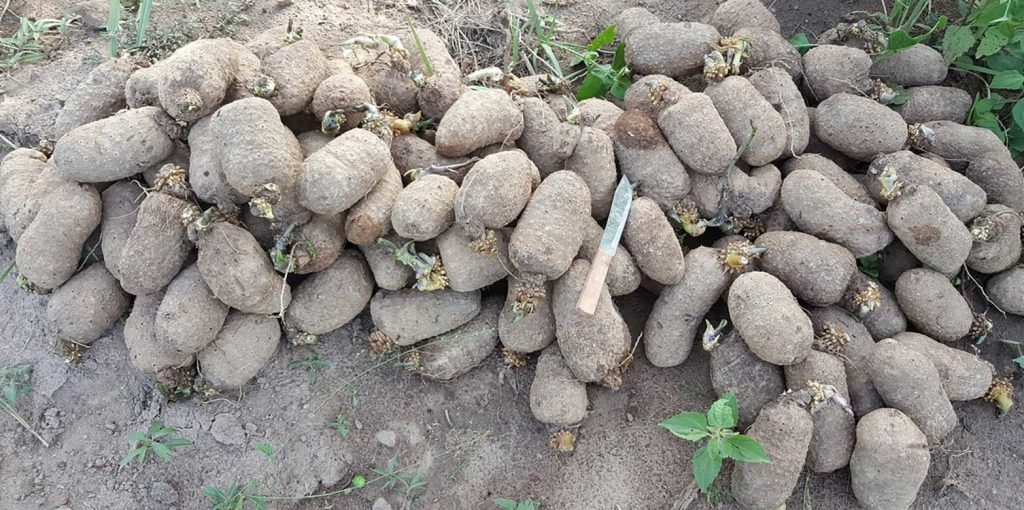

Yams are bulb plants as well as a necessary staple food in West Africa. However the standard chopping systems are unsuccessful as well as deteriorate dirt. The YAMSYS job looks for to alter this together with regional stars functioning along the yam worth chain.
Yams (Dioscorea types) are rarely located on the Swiss supper plate, however remarkably, some Swiss natural farmers generate and also market yams (Lichtwurzel) for their advantages to human wellness. You could additionally discover yam items in drug stores.
Nonetheless, the biggest yam markets are discovered in the tropics, particularly West Africa. Besides being an extremely important staple food, they are likewise a vital resource of cash money for farmers expanding them. As well as yams play a functional social function: they are made use of in inaugural, wedding celebration, and also lasts rites as well as entire yam events are arranged prior to gathering them.
However why should we work with yams?
There are really 600 yam varieties worldwide, as well as just around 20 are grown. Yet little study has actually been done on these plants in spite of their value. Hence, yams are taken into consideration an “orphan plant”. On the various other hand, dirt fertility deficiency has actually been continuously stated as an element that restricts yams as well as various other plants manufacturing in West Africa. Consequently we have actually been operating in Ivory Coast as well as Burkina Faso given that January 2015 on a transdisciplinary task, called YAMSYS, to enhance dirt fertility administration for lasting yam manufacturing.
Biodiversity under stress
Typically, West African farmers expand yams with no plant foods or chemicals. Yet yams require a really high degree of dirt fertility, so the farmers grow them straight after reducing as well as shedding the long-lasting woodland- or savanna-derived fallow, or the “all-natural” plant life that got on the area. Nonetheless, yam bulb returns get on the ordinary less than 10 loads each hectare annually, which is hardly a fifth of the prospective return.
Additionally, as the populace thickness raises in West Africa, surface areas under “all-natural” greenery or old fallows are coming to be scanter and also an increasing number of remote from towns. Hence returns are forecasted to go also better down if administration is not enhanced. And also this will certainly cause an enhanced loss of biodiversity as a result of increasingly more stress to reduce high-biodiversity plant life better from the town.
Audit for neighborhood restraints
Although the sources of dirt deterioration are understood and also strategies to recover dirt fertility have actually revealed appealing outcomes, few of these strategies have actually been embraced by smallholders. Experience has actually educated us that the transfer of technological remedies to farmers in the contexts of West Africa frequently falls short, due to the fact that researchers do not pay enough focus on the variety of restrictions farmers are encountering. Comprehending these restraints, nonetheless, calls for the facility of a discussion with the stars entailed.
Therefore, the relevant concern is: What can we carry out in order to advertise procedures that serve as well as taken on in a lasting fashion?
Initially, we devoted to attend to these obstacles in an interdisciplinary fashion. Prospective technological services could be stemmed from fundamental agronomic concepts: including raw material, mineral plant foods, making use of healthy and balanced seeds, utilizing boosted growing product, expanding the plant in long-lasting turnings (sequence of societies) and so on. Yet these actions should do greater than just feature practically in a regional context, they additionally have to serve as well as practical from the viewpoint of both business economics (do they repay) and also culture (social duty of yams, compatibility with ideas as well as taboos).
Second, we chose to collaborate with one of the most vital stakeholders associated with the yam worth chain in supposed technology systems. These systems consist of reps of the farmers, plant food and also chemical vendors, farming expansion companies, yam carriers, investors and also cpus in addition to the authorities, media, micro-credit firms as well as research study establishments.
With each other we determined and also placed one of the most vital traffic jams for yam manufacturing: land deficiency, uncertain rains, dirt fertility deficiency as well as bad-quality growing products (“seeds”). As land deficiency as well as environment are challenging to resolve, we determined with each other to mostly create procedures to enhance seed high quality and also dirt fertility.
Stories showing the manufacturing of high-grade yam seeds have actually been developed for 2 years as well as made use of as institution areas and also as a resource of seeds for farmers. In parallel, we are examining site-specific incorporated dirt fertility administration techniques (entailing making use of boosted yam cultivar, and also various sorts of nutrient inputs and also plant turnings) in “regulated” areas taken care of by the YAMSYS group. These very first area experiments reveal appealing cause some websites, with root returns a lot more than those observed in farmers’ areas.
In springtime 2017, farmers began to determine advancements of rate of interest and also to evaluate them in their very own areas. The YAMSYS group will certainly not interfere in their areas however will certainly keep an eye on farmers’ returns, the effect of embraced advancements on revenue, and also’ readiness to futher carry out these developments.
This is the very first time that such a comprehensive technique has actually been considered an exotic bulb plant. We believe that this layout will certainly make a lasting payment to enhanced food protection, revenue as well as ecological sustainability for smallholders in West Africa.