
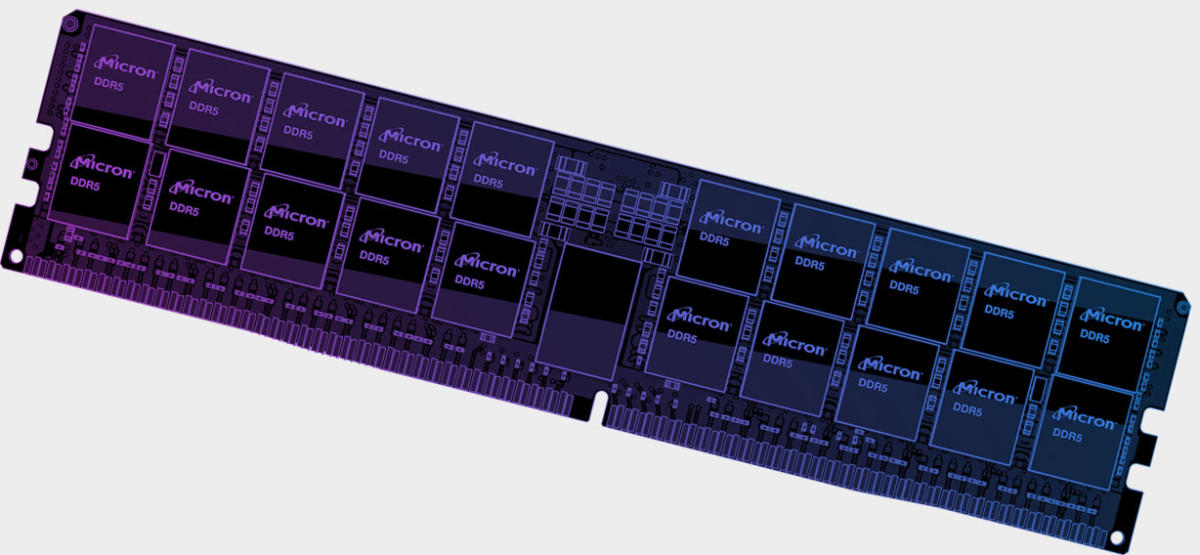

Micron is on a tear, it seems. The company recently announced the world’s first “Gen 2” version of its third-generation high-bandwidth memory (HBM3) that offers increased bandwidth and density over existing technology, Now it’s showing off a roadmap that includes some compelling numbers for the future of DDR5 and GDDR7 for gaming PCs, and HBM memory for data centers. However, arriving at these impressive numbers will take a few years, so don’t get your hopes up just yet.
This week, Micron announced it had begun shipping its brand new HBM3 Gen 2 technology to some of its customers, and a brief mention of its plans was tucked into the bottom of that announcement. The little side note included the statement, “In the first half of calendar 2024, the company plans to make available its 1β 32Gb monolithic DRAM die-based 128GB DDR5 modules.” As Tom’s Hardware notes, the company was the first to market with a 24Gb DDR5 die, which was used to create the all-new non-binary 24GB and 48GB memory kits. Now it’s preparing to leapfrog that technology with a 32Gb module, which would pave the way for a sizable increase in density and capacity across its portfolio of products.
The roadmap (above) shows its plans across four product lines: server-based HBM, GDDR6/7 for GPUs, DDR5 for PCs, and LPDRAM for low-power devices. The most interesting development for PC users is that the company plans to ship 128GB DDR5 modules in the first half of 2024. That will increase to 192GB in late 2025, followed by 256GB+ in 2026. This will eventually clear the path for a 1TB module using 32 stacks of 8-layer 32Gb modules, which won’t be possible for many years. Gamers won’t need 1TB of memory, even though we might want it, so this will be for servers and data centers.
What gamers do want is faster memory for their GPUs, and Micron plans to deliver GDDR7 with speeds up to 32Gb/s using its existing 16-24GB modules in 2025. This is the same time Nvidia is expected to announce its 50-series GPUs, and it’s always used Micron for the GDDR6X modules on its fastest GPUs, so this seems like a natural pairing. A week ago, Samsung announced its own GDDR7 technology, so an arms race is clearly brewing between these memory behemoths.
This new 32Gb module is manufactured on Micron’s 1β (1-beta) node, which is its most advanced process, but it notably does not use extreme ultraviolet lithography (EUV). It’ll be sticking with 1-beta for a while, though, as its successor—1-gamma—will start production in Taiwan and Japan in 2025. This marks a bit of a slowdown for Micron as it previously announced 1-alpha in 2021, followed by 1-beta in late 2022.
ExtremeTech supports Group Black and its mission to increase greater diversity in media voices and media ownerships.
© 2001-2023 Ziff Davis, LLC., a Ziff Davis company. All Rights Reserved.
ExtremeTech is a federally registered trademark of Ziff Davis, LLC and may not be used by third parties without explicit permission. The display of third-party trademarks and trade names on this site does not necessarily indicate any affiliation or the endorsement of ExtremeTech. If you click an affiliate link and buy a product or service, we may be paid a fee by that merchant.