Physics

Paradox Free Time

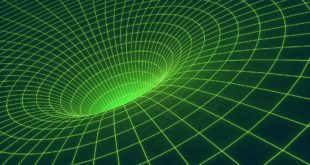
Time travel with free will is logically possible in our Universe without any paradox, according to new research from the University of Queensland. Physicists seek to understand the underlying laws of the Universe. Image credit: Johnson Martin. “Classical dynamics says if you know the state of a system at a …

Read More »

Magnetoelectric Effect

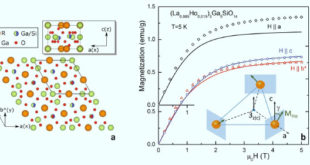
Even small changes in the direction of the magnetic field can switch the electrical properties of a paramagnetic rare-earth material — the holmium-doped langasite (HoxLa3-xGa5SiO14) — to a completely different state, according to new research published in the journal npj Quantum Materials. Crystal structure and magnetism in rare-earth langasite: (a) …

Read More »

Interstellar Gas Clouds

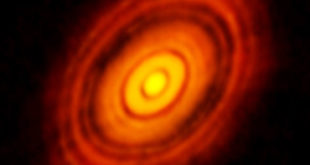
HL Tauri, a young star located 450 light-years away in the constellation of Taurus, is glowing at the center of an system of concentric protoplanetary rings and is producing planets, one for each gap in the ring. Worcester Polytechnic Institute mathematical physicist Dr. Mayer Humi believes HL Tauri provides an …

Read More »

Self-Interacting Dark Matter

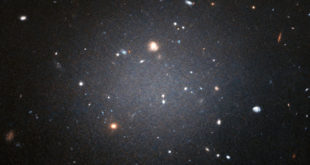
The so-called self-interacting dark matter theory helps explain why NGC 1052-DF2 and NGC 1052-DF4, a pair of ultra-diffuse galaxies located approximately 65 million light-years away the constellation of Cetus, contain little dark matter. The NASA/ESA Hubble Space Telescope took this image of NGC 1052-DF2 on November 16, 2017. Image credit: …

Read More »

Mass Black Hole

Astronomers using the twin LIGO detectors located in Livingston, Louisiana, and Hanford, Washington, and the Virgo detector located near Pisa, Italy, have detected gravitational waves from the most massive binary black hole merger ever discovered. The two spinning black holes merged when the Universe was only about 7 billion years …

Read More »

Earth’s Inner Core

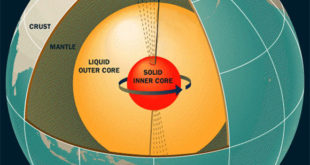
The inner core of our planet is between 1 and 1.3 billion years old, according to new research led by the University of Texas at Austin and Carnegie Institution for Science. Earth’s internal structure: dense solid metallic core, viscous metallic outer core, mantle and silicate based crust. Image credit: NASA. …

Read More »

Quantum Time Crystal

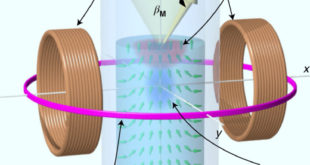
An international team of physicists has studied the controlled interaction of two spatially separated time crystals. Experimental set-up. Quartz-glass sample container cylinder is filled partially with superfluid 3He-B, leaving a free surface of the superfluid approximately 3 mm above the centre of the surrounding coil system. The space above the …

Read More »

Photon Collisions

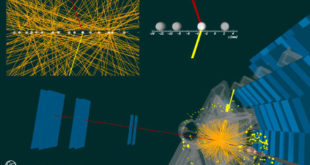
Produce Pairs of Weak-Force Carriers  Produce Pairs of Weak-Force CarriersPhysicists from the ATLAS (A Toroidal LHC ApparatuS) Collaboration at CERN’s Large Hadron Collider have observed production of W bosons, elementary particles that carry the weak force, from photons colliding with photons. This new result confirms one of the main predictions …

Read More »

Higgs Boson Muons

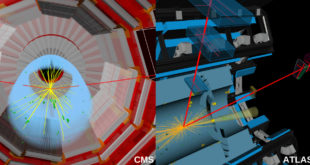
Physicists from the ATLAS (A Toroidal LHC ApparatuS) and CMS (Compact-Muon-Solenoid) collaborations at CERN’s Large Hadron Collider have reported strong evidence for the Higgs boson decay to a pair of muons. Candidate event displays of a Higgs boson decaying into two muons as recorded by CMS (left) and ATLAS (right). …

Read More »

4 Charm Quark Particle

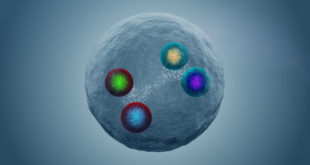
CERN Physicists Discover Four-Charm-Quark Particle   Physicists from CERN’s LHCb Collaboration have discovered a new tetraquark particle, named X(6900), composed of two charm quarks and two charm antiquarks. X(6900), a tetraquark particle composed of two charm quarks and two charm antiquarks. Image credit: CERN. Quarks are point-like elementary particles that …

Read More »
Bizwhiznetwork Consultation