Physics

Optical ‘Tractor Beam’ Traps Biological Cells
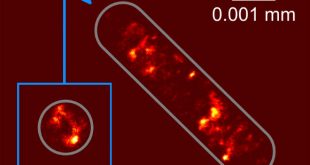
Physicists in Germany have developed a novel technique for trapping biological cells with a laser beam. Using this technique, the researchers obtained super-resolution images of chromosomal DNA within E. coli cells. Picture of the distribution of the genetic information in an E. coli cell. Image credit: University of Bielefeld. “One …

Read More »

2016 Gets Longer with Extra Second Added to New Year Countdown

This New Year’s countdown will be one second longer as the National Physical Laboratory — the UK’s national measurement institute and the birthplace of atomic time — introduces the 27th leap second into UTC. The additional second will keep the timescale based on atomic clocks in sync with time based …

Read More »

Physicists Give Schrödinger’s Cat Second Box

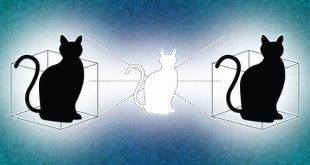
Through new experiments involving the Schrödinger’s cat state paradox, physicists at Yale University have shown that the famous cat can be in two separate locations at the same time. Chen Wang and co-authors have given Schrödinger’s cat a second box to play in. Image credit: Michael S. Helfenbein / Yale …

Read More »

Physicists Identify Second Gravitational-Wave Event

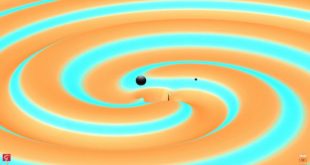
An international team of scientists has identified a second gravitational wave event in the data from the twin detectors of the Laser Interferometer Gravitational-Wave Observatory (LIGO). This image depicts two black holes just moments before they collided and merged with each other, releasing energy in the form of gravitational waves. …

Read More »

CERN Physicists Observe Three New Tetraquark Particles

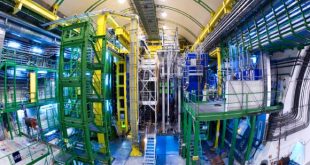
Physicists on CERN’s LHCb collaboration say they’ve observed three new exotic particles – X(4274), X(4500) and X(4700) – and also confirmed the existence of a fourth one, X(4140). According to the scientists, each of these particles contains two quarks and two antiquarks. View of the LHCb detector. Image credit: CERN. …

Read More »

Physicists Shed New Light on How Neutrinos Behave

Physicists from the NOvA collaboration have announced a new result that could improve our understanding of the behavior of neutrinos. NOvA detector. Image credit: Louise Suter / NOvA Collaboration. Neutrinos are tiny, nearly massless subatomic particles that travel at near-light speed. They have previously been detected in three types, called …

Read More »
Bizwhiznetwork Consultation