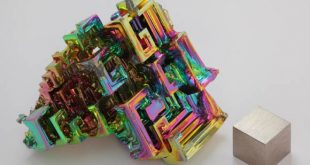
According to a team of researchers at the Tata Institute of Fundamental Research (TIFR) in Mumbai, India, pure bismuth — a semimetal with a rhombohedral structure — is superconducting at ultra-low temperatures. Artificially grown bismuth crystal illustrating the stairstep structure, with a 1 cm3 cube of bismuth metal. Image credit: …
Read More »Physicists Demonstrate Existence of Two States of Liquid Water
There are two states of liquid water, says an international team of physicists led by Oxford University’s Dr. Laura Maestro. L.M. Maestro et al find that two states of liquid water play an important role in the thermal and optical properties of nanomedical systems; the team’s preliminary findings also suggest …
Read More »Physicists Observe Butterfly Rydberg Molecule for First Time
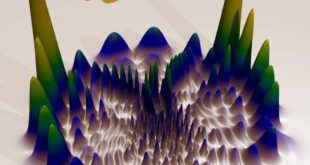
An international team of physicists, led by Prof. Chris Greene from Purdue University and Prof. Herwig Ott from the University of Kaiserslautern, has observed a butterfly Rydberg molecule, a weak pairing of two highly excitable atoms. Their work was published in the Oct. 5 issue of the journal Nature Communications …
Read More »An ‘acoustic prism’ can split sound the way a regular prism splits light
Here’s a new invention that, while potentially useful, is even more interesting as an illustration of the nature of sound: the acoustic prism. When light enters a prism made of some refractive material, the sub-components of that light have their paths affected slightly differently, based on their wavelength (color); the …
Read More »Scientists are closing in on turning hydrogen into a metal
Like modern day alchemists, scientists are attempting to transform a common element into a precious metal. This isn’t about making lead into gold, but turning elemental hydrogen into a different, never before seen form of hydrogen. Scientists are tantalizingly close to producing the first samples of solid metallic hydrogen using …
Read More »The so-called fifth force of nature is starting to look more and more real
A fifth fundamental force, perhaps discovered as part of the search for dark matter, has been reported in a new paper published in Physical Review Letters. The results still need further analysis, but they represent a step forward for an idea that has caused several months of controversy in open-source journals, …
Read More »Scientists create liquid light, get one step closer to spintronics
Strange things go on when you push physics to extremes. Extending Moore’s Law to its physical conclusion, we run into problems like the traces in circuits being so small that electrons can quantum tunnel between them. But electrons aren’t the only thing we can use to carry data through circuits. …
Read More »Astronomers observed a nova explosion for the first time by accident
For the first time, a team of scientists have captured all phases of a classical nova explosion — before, during, and after the event. The event took place back in 2009, but at first the astronomers didn’t even realize they’d captured such an unusual occurrence. After going back and looking …
Read More »The Large Hadron Collider is running out of disk space
The Large Hadron Collider (LHC) has run into an unanticipated problem — it’s running out of disk space. “This year the LHC is stable and reliable,” says Jorg Wenninger, head of operations at the LHC. “It is working like clockwork. We don’t have much downtime.” That’s actually the problem. When …
Read More »Scientists develop a memristor that can be conditioned just like a real synapse
An international collaboration of researchers from UMass Amherst, HP, and the Air Force have built a proof-of-concept memristor that could lead to real-world neuromorphic chips. The memristor is made of a silicon-oxygen-nitrogen material laced with clumps of silver nanoparticles at the electrical terminals. When current is applied across the memristor, the silver nanoparticles shuffle around …
Read More »