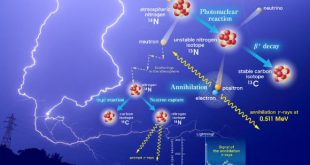
Scientists from Japan and Singapore report in the November 23 issue of the journal Nature that they observed positron (antimatter counterpart of the electron) and neutron signals after lightning. Enoto et al describe how gamma rays from lightning react with the air to produce radioisotopes and even positrons. Image credit: …
Read More »Earth Can Absorb High-Energy Neutrinos, Physicists Find
Neutrinos are subatomic particles that are famous for passing through anything and everything. Now, physicists have demonstrated that our planet stops high-energy neutrinos — they do not go through everything. The experiment was achieved with the IceCube Observatory, an array of 5,160 basketball-sized sensors frozen deep within a km3 of …
Read More »New Study Rewrites First Seconds of Chernobyl Accident
According to an analysis published in the journal Nuclear Technology, the first of the two major explosions reported by eyewitnesses of the Chernobyl disaster was a nuclear and not a steam explosion. Chernobyl disaster aftermath: reactor 4 (center), turbine building (lower left) and reactor 3 (center right). “Numerous studies have …
Read More »X-Rays from Accretion Disks around Rotating Black Holes Can Act as Carriers of Quantum Information
In a paper published in the journal New Astronomy, theoretical physicist Ovidiu Racorean suggests that X-ray photons emitted by accretion disks around rapidly spinning black holes — also known as Kerr black holes — have properties that make them ideal information carriers for quantum computing. An artist’s impression of an …
Read More »Innovative Interferometric Method Reveals Time of Electron Photoemission from Atom
According to Heisenberg’s uncertainty principle, it’s impossible to know both the position and the speed of an electron at any one time. However, a team of physicists in Sweden has now shown that it can be done — through superposition (interference) of two short pulses of light with different wavelengths. …
Read More »Physicists Confirm Quantum Theory Proposed in the 1930s
Professor David McKenzie from the University of Sydney and his PhD student Enyi Guo have demonstrated quantum tunneling in water — a quantum phenomenon first predicted by British theoretical physicist Dr. Ronald Wilfred Gurney in 1931. The research is published in the Proceedings of the Royal Society A. Medical sensing …
Read More »Newly Developed Metasurface Generates Structured Light Beams
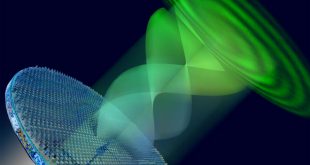
A team of researchers has developed a new tool that can produce complex states of light. The research appears in the journal Science. A metasurface uses circularly polarized light to generate and control new and complex states of light, such swirling vortices of light. Image credit: Second Bay Studio / …
Read More »Tiny Enceladus Maintains Liquid Ocean Thanks to Porous, Muddy Core
Of all Cassini’s discoveries in the 13 years it spent in orbit around Saturn, the oceanic vents of Enceladus rank among the best. Voyager 2’s flyby in 1981 had shown that some of the features on the moon might have been the result of cryovolcanoes (literally, volcanoes that shoot water, …
Read More »Swiss Physicists Set Record for Shortest Laser Pulse
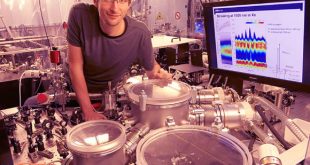
A team of physicists at ETH Zürich in Switzerland has produced the shortest-ever laser pulses: just 43 attoseconds (an attosecond is an incomprehensible quintillionith of a second). The feat surpasses the prior record of 53 attoseconds, set earlier this year. Dr. Thomas Gaumnitz, a postdoctoral fellow in Professor Wörner’s group, …
Read More »Voltage-Driven Liquid Metal Forms Snowflake-Like Fractals
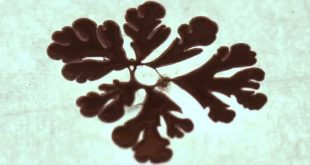
A team of scientists at North Carolina State University has demonstrated that a gallium-based liquid metal alloy forms snowflake-like fractal patterns when electrochemically oxidized. The results appear in the journal Physical Review Letters. Gallium indium forms fractal patterns with the application of low voltage. Image credit: North Carolina State University. …
Read More »