A team of physicists from the University of Rochester and the Lawrence Livermore National Laboratory has found a way to turn liquid metallic deuterium into a plasma — the fourth fundamental state of matter in the sequence: solid, liquid, gas, and plasma — and to observe the temperature where a …
Read More »Physicists Use Seven-Qubit Quantum Computer to Simulate Scrambling inside Black Holes
A team of physicists from the Joint Quantum Institute, the University of Maryland, the University of California Berkeley and Perimeter Institute for Theoretical Physics has implemented a test for quantum scrambling, a chaotic shuffling of the information stored among a collection of quantum particles. The team’s experiment, carried out on …
Read More »Physicists Create Coldest Quantum Gas of Molecules
Physicists at JILA, a joint institute of the National Institute of Standards and Technology (NIST) and the University of Colorado Boulder, have produced a gas of potassium-rubidium molecules at temperatures as low as 50 nanokelvin (nK) — that’s 50 billionths of a Kelvin, or just a smidge above absolute zero. …
Read More »Quarks Move Slower in Atoms with More Pairs of Protons and Neutrons, Physicists Find
The atomic nucleus is made of protons and neutrons, which are themselves composed of quarks and gluons. The latter two are far smaller and operate at much higher energy levels than the protons and neutrons in which they are found. Physicists have therefore assumed that a quark should be blithely …
Read More »Scientists Discover Exotic Spiraling Electrons
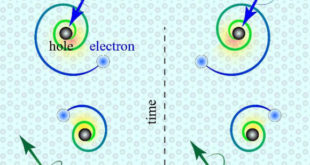
Rutgers College’s Teacher Girsh Blumberg and also associates have actually found an unique type of electrons that rotate like earths. Called chiral surface area excitons, it includes fragments and also anti-particles bound with each other as well as swirling around each various other externally of solids. The 2 kinds of …
Read More »New Type of Magnet Discovered: Singlet-Based Magnet
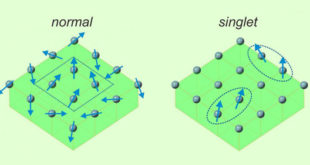
In traditional magnets, little magnetic components straighten with each other to produce a solid electromagnetic field. By comparison, the newly-discovered kind of magnet– the singlet-based magnet– has areas that appear as well as out of presence, leading to an unpredictable pressure. In a typical magnetic product, thick magnetic minutes attempt …
Read More »‘Electron Liquid’ Created at Room Temperature
A team of physicists at the University of California, Riverside, has produced the first ‘electron-hole liquid’ at room temperature. In conventional electronic devices, electricity requires the movement of electrons (blue spheres) and their positive counterparts, called holes (red spheres), which behave much like the gas molecules in our atmosphere. Although …
Read More »How Does Quantum Computing Work?
Quantum computing just plain sounds cool. We’ve all read about the massive investment in making it a reality, and its promise of breakthroughs in many industries. But all that press is usually short on what it is and how it works. That’s for a reason: Quantum computing is quite …
Read More »Physicists Uncover Quantum Structure of Buckminsterfullerene
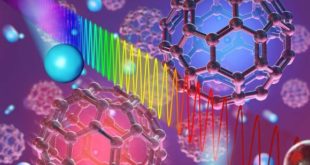
A team of physicists from the Joint Institute for Lab Astrophysics (JILA) and IMRA America Inc. has measured hundreds of individual quantum energy levels in buckminsterfullerene (nicknamed buckyball), a 60-atom molecule of carbon in the shape of a soccer ball. Changala et al used frequency combs, or ‘rulers of light,’ …
Read More »Signs of Exotic ‘Quantum Spin Liquid’ Observed in Unexpected Material
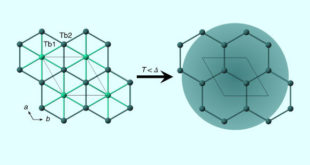
The perovskite-related metal oxide TbInO3 exhibits an exotic state of matter called quantum spin liquid, according to a team of researchers from the University of Liverpool and McMaster University. Due to the local terbium environment in TbInO3, a honeycomb lattice of terbium spins emerges in the crystal structure upon cooling. …
Read More »