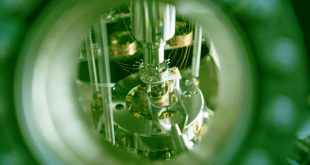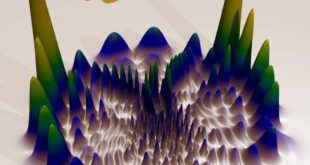
A team of physicists from the University of Birmingham and the University of Bath has identified a method to visualize, over a millionth of a billionth of a second, the initial quantum behavior of electrons on a surface. The scanning tunneling microscope used to inject electrons into a silicon surface. …
Read More »Universe is Expanding Uniformly, Scientists Say
The Universe is not spinning or stretched in any particular direction, according to a team of researchers from University College London and Imperial College London, UK. A massive cluster of yellowish galaxies, seemingly caught in a red and blue spider web of eerily distorted background galaxies, makes for a spellbinding …
Read More »Physicists Demonstrate Existence of Tetraneutron
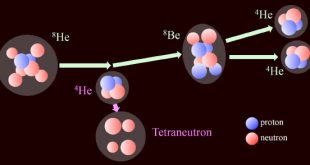
An Iowa State University-led team of physicists has demonstrated the quasi-stable existence of a tetraneutron, a subatomic structure once thought unlikely to exist. Tetra-neutron system produced in double-charge exchange reaction 4He(8He,8Be). Image credit: Susumu Shimoura / University of Tokyo. On their own, neutrons are very unstable and will convert into …
Read More »Polarized Nuclear Imaging: New Technique Has Potential for High-Resolution Medical Diagnostics
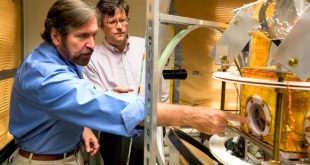
A team of researchers at the University of Virginia has devised a new imaging approach that combines powerful aspects of both magnetic resonance imaging and gamma-ray imaging. Prof. Gordon Cates and Dr. Wilson Miller with the unique imaging apparatus the team built in their lab. Image credit: Dan Addison / …
Read More »Physicists Observe Butterfly Rydberg Molecule for First Time
An international team of physicists, led by Prof. Chris Greene from Purdue University and Prof. Herwig Ott from the University of Kaiserslautern, has observed a butterfly Rydberg molecule, a weak pairing of two highly excitable atoms. Their work was published in the Oct. 5 issue of the journal Nature Communications …
Read More »Scientists Observe Superconductivity in Single Crystals of Pure Bismuth
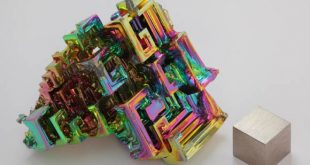
According to a team of researchers at the Tata Institute of Fundamental Research (TIFR) in Mumbai, India, pure bismuth — a semimetal with a rhombohedral structure — is superconducting at ultra-low temperatures. Artificially grown bismuth crystal illustrating the stairstep structure, with a 1 cm3 cube of bismuth metal. Image credit: …
Read More »Physicists Demonstrate Existence of Two States of Liquid Water
There are two states of liquid water, says an international team of physicists led by Oxford University’s Dr. Laura Maestro. L.M. Maestro et al find that two states of liquid water play an important role in the thermal and optical properties of nanomedical systems; the team’s preliminary findings also suggest …
Read More »Study: Extremely Low-Oxygen Environment Leads to Heart Regeneration in Adult Mice
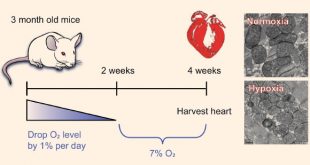
An international team of scientists from Japan, UK and the United States has been able to regenerate heart muscle by placing adult mice in a low-oxygen environment. Schematic of gradual induction of severe hypoxemia. Image credit: Yuji Nakada et al, doi: 10.1038/nature20173. The team, led by University of Texas Southwestern …
Read More »New Study Spotlights Brain Region Responsible for Placebo Response in Pain
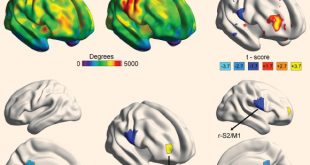
A Northwestern University-led team of researchers has identified a region in the brain responsible for the ‘placebo effect’ in pain relief, when a fake treatment actually results in substantial reduction of pain. In the study, whole-brain degree count maps, collected before the start of treatment, were used to identify potential …
Read More »New Research Provides Path to Study Diabetic Complications
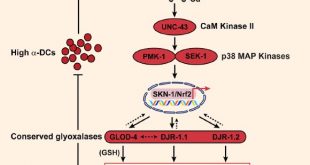
An international team of scientists from the United States and China has found a sensor for the reactive molecules linked to diabetic complications. The study, done in the nematode worm Caenorhabditis elegans, provides particular promise for those suffering from painful diabetes-related nerve damage. TRPA-1/TRPA1 activation via a-dicarbonyls (a-DCs) is relayed …
Read More »