December 14, 2016
Physics
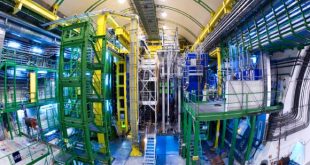
Physicists on CERN’s LHCb collaboration say they’ve observed three new exotic particles – X(4274), X(4500) and X(4700) – and also confirmed the existence of a fourth one, X(4140). According to the scientists, each of these particles contains two quarks and two antiquarks. View of the LHCb detector. Image credit: CERN. …
Read More »
December 14, 2016
Physics
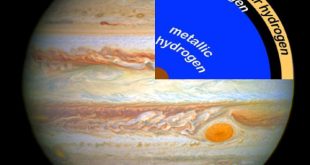
On the surface of giant gaseous planets, hydrogen is a gas. But between this gaseous layer and the liquid metal hydrogen in the planet’s core lies a layer of dark hydrogen, says a team of physicists led by Dr. Alexander Goncharov from Carnegie Institution of Washington and University of Edinburgh …
Read More »
December 14, 2016
Physics
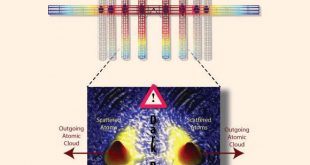
An international team of scientists, led by Dr. Niels Kjærgaard from the University of Otago in Dunedin, New Zealand, has used steerable ‘optical tweezers’ to split ultracold clouds of potassium-40 (40K) atoms and smash them together to directly observe a key principle of quantum mechanics – the Pauli exclusion principle. …
Read More »
December 14, 2016
Physics
Physicists from the NOvA collaboration have announced a new result that could improve our understanding of the behavior of neutrinos. NOvA detector. Image credit: Louise Suter / NOvA Collaboration. Neutrinos are tiny, nearly massless subatomic particles that travel at near-light speed. They have previously been detected in three types, called …
Read More »
December 14, 2016
Physics
According to a team of physicists at Imperial College London (ICL), UK, it is possible to create a new form of light by binding light to a single electron, combining the properties of both. Artistic image of light trapped on the surface of a topological insulator. Image credit: Vincenzo Giannini. …
Read More »
December 14, 2016
Physics
A physicist at Griffith University in Australia has solved an anomaly of conventional physics and shown that a mysterious effect called ‘T violation’ could be the origin of time evolution and conservation laws. Dr. Vaccaro is challenging the conventional view of space and time to show how the world advances …
Read More »
December 14, 2016
Physics
Recent findings by a team of experimental nuclear physicists in Hungary indicating the possible discovery of a new subatomic particle may be evidence of a fifth force of nature, according to a team of theoretical physicists at the University of California, Irvine. The discovery of a possible fifth force of …
Read More »
December 14, 2016
Physics
For the first time, physicists have discovered that in an extremely high magnetic field ‘massless’ Dirac electrons can acquire a mass. A false-color high-resolution transmission electron microscopy image of the zirconium pentatelluride (ZrTe5) with an inset selected area electron diffraction (SAED) pattern, showing the layer normal along the b axis. …
Read More »
December 14, 2016
Physics
An international team of physicists, led by the University of the Witwatersrand (UW) in Johannesburg, South Africa, predicts the existence of a new particle that might aid in the understanding of dark matter. Proton-proton collisions events in which two high energy electrons and two high energy muons are observed. Image …
Read More »
December 14, 2016
Physics
Plutonium, a heavy, silvery metal with 15 isotopes that is produced by the neutron irradiation of natural uranium, is formidably complex element that does not always act as expected. New research published in the journal Physical Review B shows that plutonium does not share electrons when it bonds with fluorine …
Read More »