December 10, 2020
Medicine
According to a new study published in The BMJ, substituting high quality plant foods such as legumes, nuts, or soy for red meat might reduce the risk of coronary heart disease; substituting whole grains and dairy products for total red meat, and eggs for processed red meat, might also reduce …
Read More »
December 10, 2020
Biology
Wild giant pandas (Ailuropoda melanoleuca) not only frequently sniff and wallow in fresh horse manure at low ambient temperatures, but also actively rub the fecal matter all over their bodies. Beta-caryophyllene and caryophyllene oxide-induced horse manure rolling behavior of Ginny, the giant panda at Beijing Zoo. Image credit: Zhou et …
Read More »
December 10, 2020
Paleontogly
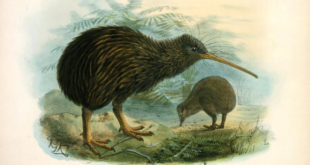
Some probe-foraging birds locate their buried prey by detecting vibrations in the substrate using a specialized tactile bill-tip organ. This remarkable ‘sixth sense’ is known as remote touch, and the associated organ is found in probe-foraging species belonging to both the palaeognathous (in kiwi) and neognathous (in ibises and shorebirds) …
Read More »
December 10, 2020
Paleontogly
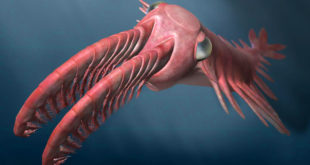
A team of paleontologists from Australia and the United Kingdom has found that ancient deep-sea creatures called radiodonts developed sophisticated eyes over 500 million years ago (Cambrian period), with some specially adapted to the dim light of deep water. An artist’s reconstruction of ‘Anomalocaris’ briggsi. Image credit: Katrina Kenny. Radiodonts …
Read More »
December 10, 2020
Paleontogly
A new genus and species of probainognathian cynodont that roamed our planet during the Triassic period has been identified from two fossilized specimens found in southern Brazil. Life reconstruction of Agudotherium gassenae. Image credit: Márcio L. Castro. The new cynodont species lived approximately 218 million years ago (Late Triassic epoch). …
Read More »
December 10, 2020
Biology
Marine biologists from the United States and the United Kingdom have recorded over 100 deep water-dwelling cutthroat eels, identified as Ilyophis arx, at a 1 kg bait package deployed on an abyssal seamount summit in the southwestern Clarion-Clipperton Zone in the central Pacific Ocean. This is the highest number of …
Read More »
December 10, 2020
Biology
An international team of researchers has discovered microbial life, in particular bacterial vegetative cells, in up to 1.2-km-deep and up to 120 degrees Celsius hot sediments in the Nankai Trough subduction zone off Cape Muroto, Japan. A microbial cell (center of the picture) detected from a sediment core sample at …
Read More »
December 10, 2020
Archeaology
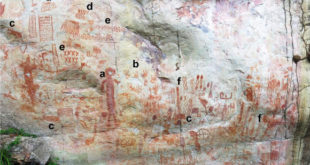
Archaeologists on the ERC project LASTJOURNEY have discovered spectacular rock pictographs in three separate rock shelters in the Guaviare Department of Colombia. The drawings, made around 12,600 and 11,800 years ago, provide proof the Amazon rainforest’s earliest inhabitants lived alongside now-extinct Ice Age animals such as giant sloths and mastodons. …
Read More »
December 10, 2020
Archeaology
Obesity is rare in hunter-gatherer cultures. Nevertheless, dozens of handheld ‘Venus’ figurines — the oldest art sculptures of humans known and tend to be of women who have obesity or are pregnant — have been identified that date to Ice Age European hunter-gatherers from 38,000 to 14,000 years ago. In …
Read More »
December 8, 2020
Space Exploration
NASA launched the Voyager probes more than 40 years ago, and the fact we’re still talking about the impact of these spacecraft is a testament to how well-planned these missions were. Both Voyager 1 and 2 are outside the solar system now, but there’s plenty to see out there …
Read More »