December 20, 2020
Space Exploration
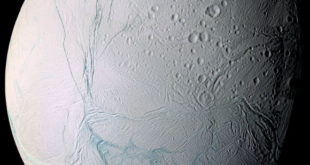
In a study published this month in the journal Icarus, planetary researchers from the United States and Germany modeled chemical processes in the subsurface ocean of Enceladus, the sixth-largest of Saturn’s moons. Enceladus’ tiger stripes are known to be spewing ice from the moon’s icy interior into space, creating a …
Read More »
December 17, 2020
Paleontogly
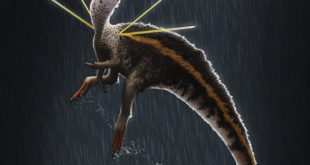
A maned theropod dinosaur with elaborate filamentous structures has been identified by a research team led by University of Portsmouth paleontologists. Life restoration of Ubirajara jubatus. Image credit: Bob Nicholls, paleocreations.com. The newly-discovered dinosaur species lived about 110 million years ago (Aptian stage of the Cretaceous period) in what is …
Read More »
December 17, 2020
Medicine
Water suppresses vasopressin, a hormone linked to fructose-induced obesity and diabetes, according to a new study published in the journal JCI Insight. Andres-Hernando et al. suggest that increased water intake may be a beneficial way to both prevent or treat metabolic syndrome. Image credit: Bernd Scheumann. “The clinical significance of …
Read More »
December 17, 2020
Paleontogly
A team of paleontologists from the University of Bristol and the Oxford University Museum of Natural History has digitally reconstructed the brain of Thecodontosaurus antiquus, a species of small sauropodomorph dinosaur that lived some 205 million years ago (Late Triassic epoch), and found that this dinosaur may have eaten meat, …
Read More »
December 17, 2020
Genetics
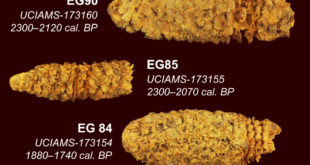
The domestication of corn (Zea mays ssp. mays), a global food staple with great economic and cultural importance, began in southwestern Mexico 9,000 years ago and humans dispersed this important grain to South America by at least 7,000 years ago as a partial domesticate. South America served as a secondary …
Read More »
December 15, 2020
Space Exploration
Humans have wrestled with the nature of the universe since time immemorial, but we’ve had science to guide us in recent generations. Most experts on physics and cosmology accept the inflation model, a straight line from the Big Bang to our infinitely expanding universe. However, some scientists hold onto …
Read More »
December 15, 2020
Space Exploration
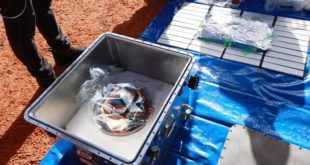
Japan’s Hayabusa2 mission wrapped up last week when the sample container parachuted down in Australia. The mission certainly looked like a success at every step along the way, but the true test is whether or not it collected the sample it flew out there to get. Today, the Japanese …
Read More »
December 15, 2020
Biology
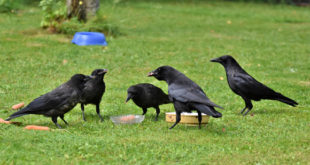
By 4 months of age, the cognitive performance of common ravens (Corvus corax) in experimental tasks is similar to those of two great ape species, chimpanzees (Pan troglodytes) and orangutans (Pongo pygmaeus). Pika et al. conducted the first systematic, quantitative large-scale assessment of physical and social cognitive performance of common …
Read More »
December 15, 2020
Paleontogly
Pterosaurs were highly successful reptiles that lived between 210 and 65 million years ago. They were the first vertebrates to evolve powered flight, but their origin has remained an unresolved enigma in paleontology since the 19th century. With the help of pterosaur skulls and skeletons that were unearthed in North …
Read More »
December 15, 2020
Physics
An international team of experimental physicists from the University of Queensland and Nokia Bell Labs has generated time reversed optical waves with a device capable of independently controlling all of light’s classical degrees of freedom simultaneously. Mounaix et al. develop a new technique to demonstrate the time reversal of optical …
Read More »