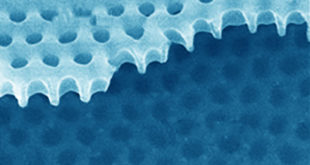
An international team of physicists and materials scientists from the United States and China has discovered a new state of matter they’ve named ‘Cooper pair metal.’ Tiny holes punched into a high-temperature superconducting material revealed that Cooper pairs can also conduct electricity the way metals do. Image credit: Brown University. …
Read More »Natural Genetic Engineering Allowed Plants to Move from Water to Land
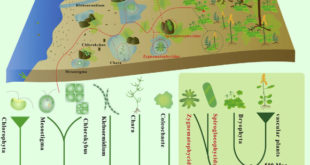
Horizontal gene transfer from soil bacteria to algae allowed early life to move to land, according to new research. Cheng et al report genome sequences and analyses of two early diverging Zygnematophyceae species, Spirogloea muscicola and Mesotaenium endlicherianum, that share the same subaerial/terrestrial habitat with the earliest-diverging embryophytes, the bryophytes. …
Read More »NASA’s Curiosity Rover Spots Unexplained Oxygen Spike on Mars
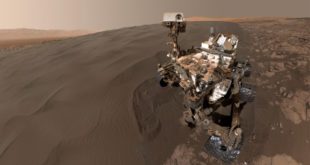
The Curiosity rover has already had a tremendously successful mission on Mars, but it’s not done making discoveries yet. NASA reports that the rover has detected a perplexing increase in oxygen concentrations on the red planet. While the cause is unclear, this comes just months after the rover detected …
Read More »SpaceX Successfully Tests Crewed Dragon Launch Abort Engines
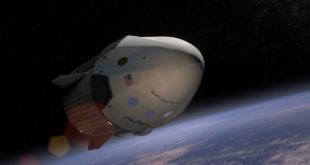
SpaceX has cleared a major hurdle on the way to launching manned missions with its Dragon spacecraft. The company had to push back its launch plans after the stunning explosion of a Crew Dragon capsule during testing earlier this year. Now, SpaceX has successfully tested the engines without incident, …
Read More »Megadroughts Likely Triggered Fall of Neo-Assyrian Empire
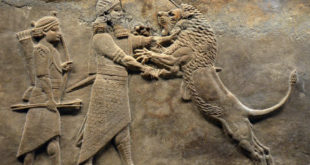
Climate-related megadroughts built the foundation for the collapse of the Neo-Assyrian Empire (912 to 609 BCE), the largest and most powerful empire of its time, a new study published in the journal Science Advances suggests. The rise of the Neo-Assyrian Empire occurred during a two-centuries-long interval of anomalously wet climate …
Read More »Gigantopithecus is Related to Modern-Day Orangutans, New Study Shows
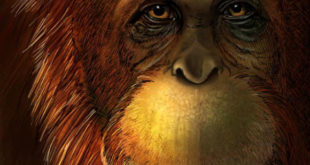
Orangutans (genus Pongo) are the closest living relatives of Gigantopithecus blacki, the biggest primate that ever walked the Earth, according to new research published in the journal Nature. Welker et al demonstrated that Gigantopithecus blacki is a sister clade to orangutans with a common ancestor about 12-10 million years ago, …
Read More »New Species of Herbivorous Dinosaur Identified in Canada
Paleontologists in Canada have found the fossil fragments from a new species of leptoceratopsid dinosaur that walked the Earth during the Cretaceous period. An artist’s impression of Ferrisaurus sustutensis. Image credit: Raven Amos / Royal BC Museum. The newly-discovered dinosaur lived approximately 67 million years ago (Cretaceous period). Named Ferrisaurus sustutensis, …
Read More »Entomologist Discovers New Ant Species in His Own Backyard
Dr. John Longino, an ant expert in the Department of Biology at the University of Utah, has discovered a new ant species in an urban yard in Salt Lake City, Utah. Strumigenys ananeotes. Image credit: Jack Longino / University of Utah. In August 2018, Dr. Longino caught a glimpse of …
Read More »NASA’s Mars Reconnaissance Orbiter Finds Hydrated Silica in Jezero Crater
Using data from the Compact Reconnaissance Imaging Spectrometer for Mars (CRISM) instrument aboard NASA’s Mars Reconnaissance Orbiter, researchers have detected hydrated silica — a mineral good at preserving biosignatures — in Jezero Crater, the landing site of the agency’s upcoming Mars 2020 rover mission. This image from NASA’s Mars Reconnaissance …
Read More »Researchers Find More Than 1 Million Alternatives to DNA
Life on Earth uses DNA and RNA to store and utilize genetic information, but what if there’s another way? A new analysis from researchers at Emory University and the Tokyo Institute of Technology suggests a plethora of molecules could serve the same basic task of organizing and storing genetic …
Read More »