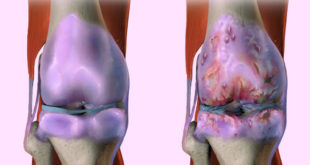
A new study, published in the journal Menopause, shows that women receiving menopausal hormone therapy had a significantly lower prevalence of symptomatic knee osteoarthritis compared with women who did not take hormones. Knee osteoarthritis, also known as degenerative joint disease, is typically the result of wear and tear and progressive …
Read More »Can Technology Cure Our Healthcare Ills?
LAS VEGAS — As we’re all too painfully aware, health care costs have continued to rise precipitously in the US. While technology continues to make huge advances in healthcare in general, with few exceptions it has not contributed much to a reduction in cost in the delivery of health …
Read More »New Study Shows How Exercise Reduces Abdominal Fat Mass
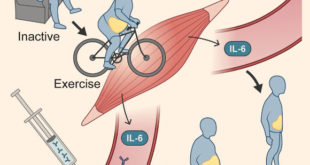
Abdominal (belly) fat is harmful to metabolic health. Exercise training reduces abdominal fat mass, but the underlying mechanisms have not been clear. According to a new study, published in the journal Cell Metabolism, a signaling molecule called interleukin-6 plays a key role in this process. Wedell-Neergaard et al show that …
Read More »Neuronal Loss May Have Beneficial Effect in Alzheimer’s Disease
Neuronal loss in Alzheimer’s disease may be the result of a cell quality control mechanism trying to protect the brain from the accumulation of malfunctioning neurons, according to new research published in the journal Cell Reports. Multicellular organisms eliminate abnormal but viable cells based on their fitness status through cell …
Read More »Study: Dietary Fructose and Glucose Target Good Gut Bacteria
Dietary fructose and glucose, which are prevalent in the Western diet, silence a key protein that is necessary for gut colonization, but not for utilization of these sugars, by a beneficial bacterium called Bacteroides thetaiotaomicron, according to new research from Yale School of Medicine. Bacteroides thetaiotaomicron. Image credit: Kathryn Cross …
Read More »Implantable Vagus Nerve Stimulation Device Aids Weight Loss
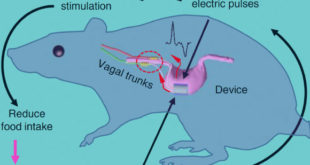
An international team of researchers led by University of Wisconsin-Madison scientists has developed an easily implantable weight-loss device. In lab experiments, the device helped rats shed 38% of their body weight. Operation principle of the vagus nerve stimulation (VNS) system schematically showing the pathway for biphasic electric signal generation and …
Read More »Experimental Vaccine Protects Rhesus Macaques from HIV-Like Infection
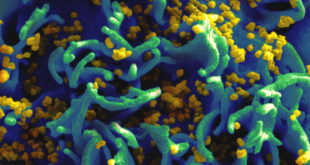
A study led by researchers from the Scripps Research Institute, the University of Pennsylvania and Harvard Medical School shows that rhesus macaques (Macaca mulatta) can be prompted to produce neutralizing antibodies against one strain of HIV that resembles the resilient viral form that most commonly infects people, called a Tier …
Read More »Newly-Identified Human Protein Inhibits Replication of Ebola Virus
A team of scientists led by researchers from the University of California, San Francisco, J. David Gladstone Institutes, Georgia State University and Northwestern University Feinberg School of Medicine has discovered a human protein that could one day lead to an effective therapy against Ebola virus. The discovery is reported in …
Read More »New Electronic Pill Can Communicate Wirelessly
A research team led by MIT scientists has developed an ingestible capsule that can be controlled using Bluetooth, a widely adopted wireless protocol. Manufactured using 3D-printing technology, the capsule could be deployed to deliver drugs to treat a variety of diseases. It could also be designed to sense infections, allergic …
Read More »Scientists Repurpose Wasp Venom Peptides to Fight Drug-Resistant Bacteria
After performing an analysis of the antimicrobial properties of a peptide found in the venom of Polybia paulista, a species of South American social wasp, a team of researchers at MIT has engineered several variants of the peptide that are potent against bacteria but nontoxic to human cells. In a …
Read More »