November 21, 2020
Genetics
A team of scientists at Harvard University has developed a new imaging technology for visualizing organization of chromatin, a substance within a chromosome consisting of DNA and protein, across multiple scales in single cells with high genomic throughput. Su et al. report a multiplexed error-robust fluorescence in situ hybridization (MERFISH)-based …
Read More »
November 19, 2020
Genetics
Humans, mice, zebrafish, and most likely other animals, share enhancers — DNA regions that help to regulate gene expression and evolve rapidly — with Amphimedon queenslandica, a species of sea sponge from the Great Barrier Reef, according to new research. Amphimedon queenslandica. Image credit: University of Queensland. “Some elements of …
Read More »
November 16, 2020
Genetics
Scientists from the Bird 10,000 Genomes Project have successfully sequenced and analyzed the genomes of a total of 363 bird species from 92.4% (218 out of 236) of avian families, including 267 bird species that have been sequenced for the first time. Feng et al. report a substantial step towards …
Read More »
November 4, 2020
Genetics
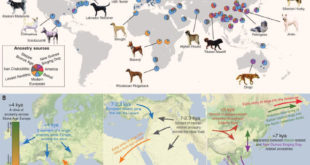
In a new study published in the journal Science, an international team of scientists sequenced the genomes of 27 ancient dogs, some of which lived up to nearly 11,000 years ago, across Eurasia. The researchers found that dogs likely arose once from a now-extinct wolf population and that by 11,000 …
Read More »
October 27, 2020
Genetics
In 2010, the Human Proteome Organization (HUPO) launched the Human Proteome Project (HPP), creating an international framework for global collaboration, data sharing, quality assurance and enhancing accurate annotation of the genome-encoded proteome. During the subsequent decade, the HPP scientists established collaborations, developed guidelines and metrics, and undertook reanalysis of previously …
Read More »
October 23, 2020
Genetics
Humans have been grafting plants onto other plants for thousands of years, but only in the last few generations have we understood the genetic implications of the technique. Researchers from Penn State and the University of Florida partnered with a Nebraska startup to combine genetically “stressed” roots with regular …
Read More »
October 21, 2020
Genetics
An international team of scientists has sequenced and analyzed the entire nuclear genome of the scimitar-toothed cat Homotherium latidens. Their results demonstrate that this extinct species was highly divergent from all living cat species and did not undergo any detectable gene flow with living cat species after their initial diversification …
Read More »
October 16, 2020
Genetics
An international team of scientists from China, Taiwan and the United States has successfully sequenced and analyzed the genomes of the Chinese banyan tree (Ficus microcarpa), which is famous for its extraordinary aerial roots; Ficus hispida, a related fig species lacking aerial roots; and Eupristina verticillata, a wasp coevolving with …
Read More »
September 30, 2020
Genetics
A team of scientists from Hong Kong, the United Kingdom and the United States has sequenced and assembled the chromosomal-level genomes of two very different millipede species: the orange rosary millipede Helicorthomorpha holstii and the rusty millipede Trigoniulus corallinus. Their results provide important insights into arthropod evolution and highlight the …
Read More »
September 25, 2020
Genetics
A team of researchers from Imperial College London, the University of Oxford and CABI has successfully sequenced the genome of Alexander Fleming’s original fungal strain behind the discovery of penicillin, now classified as Penicillium rubens, and compared it to those of two ‘high producing’ industrial strains of Penicillium rubens and …
Read More »