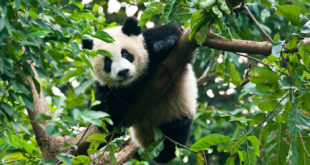
Wild giant pandas (Ailuropoda melanoleuca) not only frequently sniff and wallow in fresh horse manure at low ambient temperatures, but also actively rub the fecal matter all over their bodies. Beta-caryophyllene and caryophyllene oxide-induced horse manure rolling behavior of Ginny, the giant panda at Beijing Zoo. Image credit: Zhou et …
Read More »Discover Abyssal Depths
Marine biologists from the United States and the United Kingdom have recorded over 100 deep water-dwelling cutthroat eels, identified as Ilyophis arx, at a 1 kg bait package deployed on an abyssal seamount summit in the southwestern Clarion-Clipperton Zone in the central Pacific Ocean. This is the highest number of …
Read More »Hot Subseafloor Sediments
An international team of researchers has discovered microbial life, in particular bacterial vegetative cells, in up to 1.2-km-deep and up to 120 degrees Celsius hot sediments in the Nankai Trough subduction zone off Cape Muroto, Japan. A microbial cell (center of the picture) detected from a sediment core sample at …
Read More »Biomineral Armor
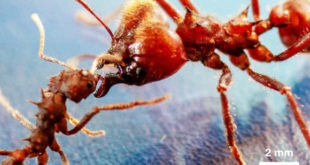
A team of researchers from the University of Wisconsin-Madison and the Smithsonian Institution has discovered a dense layer of biogenic high-magnesium calcite in the exoskeletons of major workers of the leaf-cutter ant Acromyrmex echinatior; they’ve also found that this armor accumulates rapidly as ant workers mature and that the biomineral …
Read More »Microgravity Affects Genes
A genetic analysis of transparent nematodes Caenorhabditis elegans on the International Space Station showed ‘subtle changes’ in about 1,000 genes; stronger effects were found in some genes, especially those responsible for neuronal function and cellular metabolism. Willis et al. performed comparative transcriptomic analysis of Caenorhabditis elegans responses to varying degrees …
Read More »Bee Species Worldwide
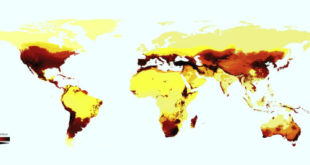
Using a uniquely comprehensive checklist of bee distributions and over 5,800,000 public bee occurrence records, a team of researchers from China, the United States and Singapore has described global patterns of bee biodiversity. Their results show that there are more bee species in the northern hemisphere than the southern hemisphere …
Read More »New Species of Primate
An international team of biologists and taxonomists has discovered a new species in the langur genus Trachypithecus living in the forests of Myanmar. The Popa langur (Trachypithecus popa). Image credit: Thaung Win. Trachypithecus is a genus of non-human primates widely distributed in Asia with about 20 known species. Commonly known …
Read More »Ultraviolet Fluorescence
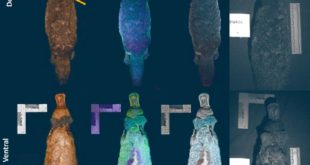
The fur of the platypus (Ornithorhynchus anatinus), one of only five extant species of monotremes (egg-laying mammals), absorbs ultraviolet light at wavelengths of 200-400 nm and re-emits visible light, making it fluoresce, according to new research from Northland College and the Warner College of Natural Resources at Colorado State University. …
Read More »Low Light Foraging Bees
Two Australian bee species, Reepenia bituberculata and Meroglossa gemmata, have adapted their vision for night-time conditions, according to a paper published in the Journal of Hymenoptera Research; both species possess enlarged compound and simple eyes which allow more light to be gathered when compared to their daytime kin. Meroglossa gemmata. …
Read More »Mountain Gorillas
Mountain gorillas (Gorilla beringei beringei) live in tight-knit groups, foraging, resting and sleeping together around a core home range and a wider peripheral range. These groups sometimes split permanently, separating gorillas that may have lived together for years and may be closely related. A new study, published in the Journal …
Read More »