University of Queensland’s Dr. Anthony Romilio has examined the ‘Meidum Geese,’ a painting from the Chapel of Itet at Meidum in Egypt. A Meidum goose (left), life reconstruction (center) and a modern red-breasted goose (right). Image credit: A. Romilio / Tambako the Jaguar. The Meidum Geese painting was found in …
Read More »Springhares Glow Orange
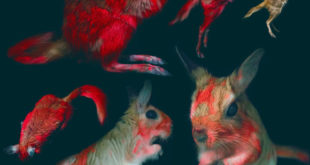
Scientists have discovered a vivid porphyrin-based biofluorescence in two species of springhares, Pedetes capensis and Pedetes surdaster. Captive Pedetes capensis photographed under visible light (three insets) and under 395 nm UV light with a 470 nm longpass filter to documenting the orange to red biofluorescence ( 650 nm) of springhare. Images …
Read More »Bacteriophage Species
A team of biologists from the Wellcome Sanger Institute, the European Bioinformatics Institute and the Universidad de los Andes has identified 142,809 species of bacteriophages — viruses that infect and replicate in bacteria — living in the human gut. Camarillo-Guerrero et al. introduce the Gut Phage Database, a collection of …
Read More »Helium Ion Microscope
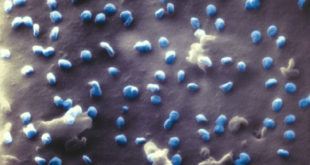
New images of the SARS-CoV-2 coronavirus demonstrate the potential of the helium ion microscopy in bioimaging, especially for the imaging of interactions between viruses and their host organisms. This helium ion microscope image shows SARS-CoV-2 virus particles (blue). Image credit: N. Frese / Bielefeld University. Helium ion microscopy offers the …
Read More »Bees And Fruit Flies
Neonicotinoid insecticides, such as imidacloprid, clothianidin, thiamethoxam and thiacloprid, affect the amount of sleep taken by both buff-tailed bumblebees (Bombus terrestris) and fruit flies (Drosophila melanogaster), according to two new studies led by University of Bristol researchers. The buff-tailed bumblebee (Bombus terrestris). Image credit: Myriam. “The neonicotinoids we tested had …
Read More »Volta’s Electric Eels
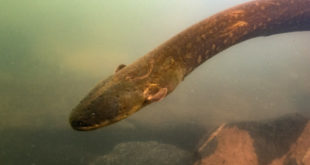
New observations made near the mouth of a small lake on the banks of the Iriri River in Brazil’s state of Pará show Volta’s electric eels (Electrophorus voltai) herding, encircling shoals of small fishes called tetras, and launching joint predatory high-voltage strikes on the prey ball. The observations, described in a …
Read More »Quadruple Helix DNA
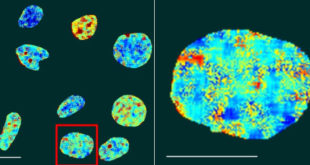
A team of scientists from the United Kingdom and Spain has demonstrated that a technique called fluorescence lifetime imaging microscopy in conjunction with a fluorescent probe can identify four-stranded ‘quadruple helix’ DNA structures within nuclei of live cells. Fluorescence lifetime imaging microscopy map of nuclear DNA in live cells stained …
Read More »New Species of Bat
An international team of researchers has discovered a new dichromatic species of bat in the Guinean Nimba Mountains belonging in the genus Myotis. An artist’s impression of Myotis nimbaensis. Image credit: Patricia Wynne. Myotis is the most speciose genus of bats with over 120 living species and a range that …
Read More »Wild Bee Discovered
An international team of scientists has discovered a new species of the bee genus Lasioglossum living in sand dunes in Israel. Head of a female of Lasioglossum dorchini. Image credit: Nahal Alexander / A. Pauly. Lasioglossum is a genus of wild bees in the family Halictidae (commonly referred to as …
Read More »Non-Photosynthetic Bacteria
A team of researchers from Germany, Denmark and the United Kingdom has identified circadian rhythms in non-photosynthetic, Gram-positive bacterium Bacillus subtilis. Bacillus subtilis. Image credit: Ákos Kovács, Technical University of Denmark. Circadian rhythms are exquisite internal timing mechanisms that are widespread across nature enabling living organisms to cope with the …
Read More »