Bald cypress trees (Taxodium distichum) over 2,000 years old grow in the forested wetlands along Black River south of Raleigh, North Carolina. One of the trees is at least 2,624-years old, making the bald cypress the oldest-known wetland tree species, the oldest living trees in eastern North America, and the …
Read More »Medusavirus: Newly-Discovered Giant Virus Turns Its Hosts into ‘Stone’
A team of researchers has isolated a new giant virus from hot spring water in Japan. Named medusavirus, the virus infects a species of amoeba called Acanthamoeba castellanii and can turn its host into a stone-like cyst. Cryo-EM image of a DNA-filled medusavirus particle viewed from a 3-fold axis; spike, …
Read More »Wolves are More Prosocial than Dogs, New Study Finds
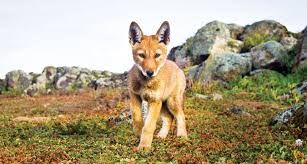
In touchscreen experiments that allowed animals to provide food to others, wolves (Canis lupus) acted more prosocially toward their pack members than did pack dogs (Canis lupus familiaris). While wolves rely heavily on cooperation, dogs do so substantially less thus leading to the prediction that wolves are more prosocial than …
Read More »Paper Wasps are Capable of Logical Thinking, Suggests New Study
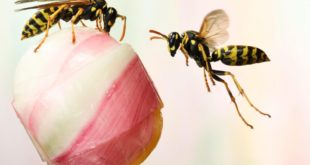
A team of researchers from the University of Michigan has found evidence of transitive inference — a form of logical reasoning that involves using known relationships to infer unknown relationships (if A is greater than B, and B is greater than C, then A is greater than C) — in …
Read More »Biologists Find Arsenic-Breathing Microbes in Oxygen-Poor Regions of Pacific Ocean
A team of marine biologists from the University of Washington has found communities of arsenic-breathing microbes in the oxygen-deficient zones of the Pacific Ocean. The findings suggest microbial arsenic metabolism may be underestimated in the modern ocean and was likely a significant contributor to biogeochemical cycles in the ancient anoxic …
Read More »Songbirds Have Unusual Chromosome in Germ Cells: Study
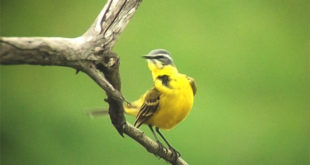
An international team of researchers has discovered that all songbirds have an additional chromosome in their germ cells — the ‘germline restricted chromosome’ (GRC). The western yellow wagtail (Motacilla flava), a small passerine bird in the family Motacillidae. Image credit: Sci-News.com. Somatic (normal) cells have two copies of each chromosome. …
Read More »Study: Giant Pandas are ‘Macronutritional Carnivores’
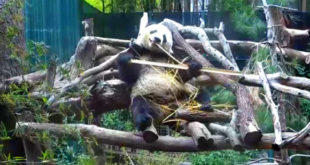
Giant pandas (Ailuropoda melanoleuca) feed almost exclusively on highly fibrous bamboo, yet they bear a mix of herbivore and carnivore traits. A new study published in the journal Current Biology shows that the macronutrient composition of the diet of giant pandas is similar to that of carnivore diets and unlike …
Read More »Study: Male and Female Bees Frequent Different Flowers
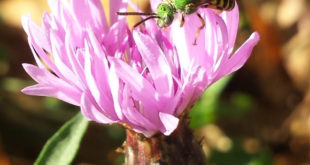
For scores of wild bee species, females and males visit very different flowers for food, according to a new study published in the journal PLoS ONE. The bicolored striped-sweat bee (Agapostemon virescens), a male, on spotted knapweed in the Rutgers-owned Hutcheson Memorial Forest in Franklin Township, Somerset County. Image credit: …
Read More »Two New Species of White-Eyes Discovered in Indonesia
Two new species of the bird genus Zosterops (white-eyes) have been discovered in the forests of the Wakatobi Archipelago, Sulawesi, Indonesia. The Wakatobi white-eye. Image credit: Seán Kelly. White-eyes as a group have spread and speciated more rapidly than any other birds. They are adaptable, feeding on a wide variety …
Read More »Biologists Find Nearly 196,000 Virus Species in Earth’s Oceans
Marine biologists on the Tara Oceans global oceanographic research expedition have identified nearly 196,000 marine virus species, which vastly exceeds the 15,000 known from prior ocean surveys and the approximately 2,000 genomes available from cultured viruses of microbes. Microbes drive most ecosystems and are modulated by viruses that impact their …
Read More »