Ever wonder why bugs run like their very lives depend on it when you discover their secret lair? Maybe it’s because more times than not, we go full Godzilla on them. Who wants to stick around to get stomped in the most gruesome way possible? Humans often shriek and make …
Read More »New Form of Biofluorescence Discovered
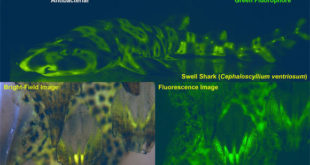
A team of U.S. researchers has discovered a previously undescribed group of small molecule metabolites responsible for the green biofluorescence in two species of sharks. Not only is the newly-discovered chemical mechanism different from how most marine creatures glow, but it may also play other useful roles for the sharks, …
Read More »Staring at Seagulls Makes Them Less Likely to Snatch Your Food
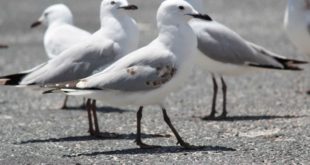
A team of researchers from the University of Exeter, UK, put a bag of chips on the ground and tested how long it took herring gulls (Larus argentatus) to approach when a human was watching them, compared to when the human looked away: on average, gulls took 21 seconds longer …
Read More »Gorillas Use Their Teeth to Crack Open and Eat African Walnuts
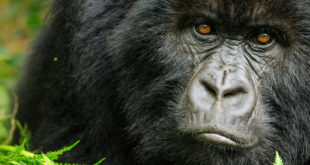
Gorilla diets are characterized by large amounts of fruits and plants. Hard-object feeding is not generally associated with these great apes as the high crests on their molar teeth would be at risk of damage from the mechanically challenging woody shell. Now, an international team of researchers from Germany and …
Read More »Study: Dinosaur Feathers Evolved for Sexual Display
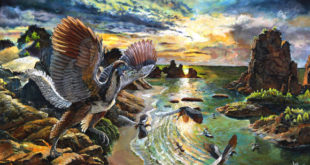
New research, published recently in the journal Evolution, shows that some dinosaurs may have taken flight thanks to sex appeal. Persons Currie explored how feathers went from dinosaur insulation to enabling flight. Image credit: Zhao Chuang / Martin Kundrát. Modern bird feathers are complicated: the feathers on a bird’s wing …
Read More »Elusive Long-Tailed Squid Captured on Film for First Time
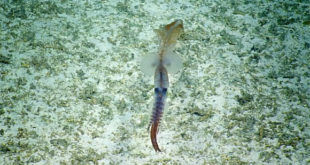
A team of marine biologists with the Nautilus Expedition succeeded in filming Asperoteuthis mangoldae, a recently discovered deep-sea squid species, at a depth of 3,151 feet (930 m) near Jarvis Seamount in the Pacific Remote Islands Marine National Monument. “On July 5, 2019, diving at 3,151 feet depth on …
Read More »One Apple Contains 100 Million Bacterial Cells, New Study Shows
Apples are among the most consumed fruits worldwide. They represent a source of direct human exposure to bacterial communities. A new study, published in the journal Frontiers in Microbiology, shows that consuming the whole apple — organic or conventional — includes an approximate uptake of 100 million bacterial cells; however, …
Read More »New Flying Squirrel Species Discovered in China
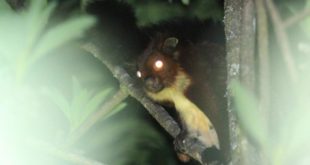
An international team of researchers has discovered a new species of the genus Biswamoyopterus living in the evergreen broad-leaved forests of Mount Gaoligong in China’s Yunnan province. The Mount Gaoligong flying squirrel (Biswamoyopterus gaoligongensis). Image credit: Kadoorie Farm Botanic Garden. Flying squirrels belong to Pteromyini, a tribe that currently includes …
Read More »New Species of Pocket Shark Discovered
A research team led by NOAA marine biologists has described a new species of pocket shark from the Gulf of Mexico. The American pocket shark (Mollisquama mississippiensis). Image credit: Michael Doosey. The newly-discovered shark species belongs to the previously monotypic genus Mollisquama. Named the American pocket shark (Mollisquama mississippiensis), the …
Read More »Study: Littered Cigarette Butts Significantly Reduce Plant Growth
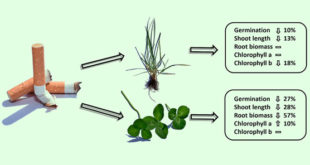
Most cigarette butts contain a filter made of cellulose acetate fiber, a type of a bioplastic. Around 4.5 trillion cigarette butts are littered every year, making them the most pervasive form of plastic pollution on the planet. A research team headed by Anglia Ruskin University’s Dr. Dannielle Green have discovered …
Read More »