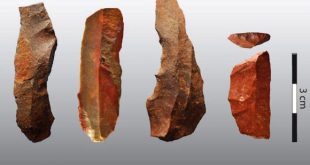
Early humans living in southern Africa in the Middle Stone Age after 65,000 years ago used advanced heating techniques to produce silcrete blades, according to a new study. This image shows heated silcrete artifacts made by Middle Stone Age humans at Klipdrift Shelter, South Africa. Image credit: Katja Douze / …
Read More »Stone Age Humans Hunted Cave Lions for Their Pelts, Research Suggests
According to a new study, Stone Age humans may have hunted Eurasian cave lions (Panthera leo spelaea) for their pelts, perhaps contributing to their extinction. Cave lion (Panthera leo spelaea) by Heinrich Harder, 1920. The Eurasian cave lion is an extinct subspecies of lion that lived on the Eurasian continent …
Read More »First Temple-Period Papyrus Mentioning ‘Jerusalem’ Found
Archaeologists with the Israel Antiquities Authority (IAA) have uncovered a papyrus fragment that includes the earliest reference to Jerusalem in an extra-Biblical document, written in ancient Hebrew script and dating to the time of the First Temple (seventh century BC). This papyrus, found in one of the Judean Desert caves, …
Read More »Nan Madol: Archaeologists Uncover Earliest Evidence of Chiefdom in Pacific
Nan Madol, an ancient administrative and the former capital of the Micronesian island of Pohnpei, was the earliest among the Pacific islands to be ruled by a single chief, according to an international team of archaeologists. Nan Madol ruins on the island of Pohnpei. Image credit: C.T. Snow / CC …
Read More »Archaeologists Find Pharaonic Boat Burial at Abydos
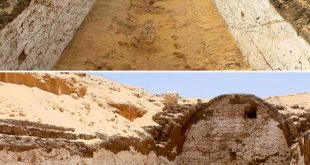
Archaeological excavations at Abydos, Egypt, have revealed the remains of a subterranean boat burial dating to the reign of the pharaoh Senwosret III (c. 1850 BC), says an international team of archaeologists led by Dr. Josef Wegner of the Penn Museum, University of Pennsylvania. Top: interior of the boat building. …
Read More »Archaeologists Unearth Bronze Age City in Iraq
An international team of archaeologists has uncovered the remains of a large Bronze Age settlement not far from the town of Dohuk in northern Iraq. The mound of ruins at Bassetki, Iraq, with the broad area of the lower town where sheep now graze. Image credit: Peter Pfälzner. The settlement …
Read More »Swedish Researchers Find Submerged Mesolithic Settlement
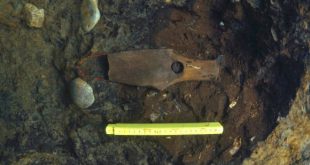
A team of researchers headed by Lund University’s Professor Dan Hammarlund has uncovered an exceptionally well-preserved Mesolithic site off the Baltic Sea coast at Haväng in south-eastern Sweden. They believe the location was a lagoon environment where ancient humans lived during parts of the year. 9,000 year-old antler pick axe; …
Read More »Ancient Zapotecs Kept and Bred Turkeys for Meat, Eggs, Religious Purposes
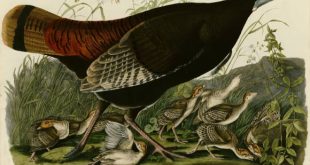
A team of archaeologists excavating the Mitla Fortress, a Zapotec site in Oaxaca, Mexico, dating to the Classic to Early Postclassic period (300-1200 CE), has uncovered the remains of juvenile and adult turkeys, whole eggs, and numerous eggshell fragments in domestic refuse and ritual offering contexts. They say this is …
Read More »Early Evidence of Dairying Discovered along Mediterranean Coast
An international research group has found evidence that humans have been utilizing milk and dairy products across the northern Mediterranean region from the onset of agriculture – approximately 9,000 years ago. C.D. Spiteri et al discovered widespread evidence of prehistoric milk production in southern Europe. Image credit: Samuel Daniell. The …
Read More »Indus Civilization Farmers Cultivated Rice Over 4,000 Years Ago, Archaeological Evidence Suggests
New research on three archaeological sites of the famed Indus Valley civilization (3000-1500 BC) in north-west India has revealed that domesticated rice farming in South Asia began far earlier than previously believed, and may have developed in tandem with — rather than as a result of — rice domestication in …
Read More »