Uranium is actually a rather common element on Earth. You can find it in small quantities within most rocks, but 99.3% of that uranium is the relatively harmless uranium-238. It’s the much more rare uranium-235 that sustains nuclear reactions and is vital in the production of nuclear weapons. Naturally, being …
Read More »Scientists finally make ‘triangulene,’ which is good, we think
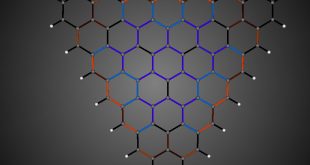
Chemists have made another compound nobody has any idea what to do with. The new weirdness is called triangulene, a cousin of graphene that’s been theorized for decades but never successfully synthesized. What do we do with it? How do we handle it? What are its properties? Other than that …
Read More »Scientists observe first planet-induced stellar pulsations
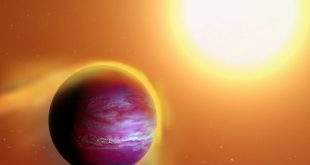
It is stars that affect planets, for the most part, and not the other way around. But researchers now claim to have found the first example of stellar pulsations caused by an exoplanet. The star HAT-P-2 is emitting visible pulses that seem to be a result of a particularly large …
Read More »Scientists Identify Brain-Signaling Molecule that Triggers Fat Burning
A research team led by Scripps Research Institute scientist Dr. Supriya Srinivasan has identified a brain hormone that appears to trigger fat burning in the gut. Model depicting the FLP-7/NPR-22 neuroendocrine axis that underlies the 5-HTergic control of body fat loss. In the nervous system, an integrated 5-HT and octopaminergic …
Read More »Scientists devise tiny spacecraft with giant light sails to visit nearest exoplanet
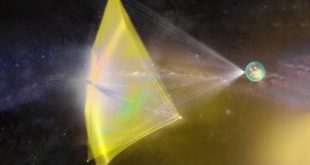
Astronomers announced several months ago that there is most likely a small Earth-like planet in orbit of Proxima Centauri. That’s a big deal because Proxima Centauri happens to be the closest star to Earth, at just a bit over four light years away. That’s still an insurmountable distance for human …
Read More »Optical shock: Scientists have imaged light going faster than itself
A team of researchers at Washington University in St. Louis has taken images of a laser pulse generating an optical Mach cone: the equivalent of a sonic boom, but for light. To make an optical Mach cone, a pulse of light would need to be traveling faster than the waves …
Read More »Scientists Use Human Pluripotent Stem Cells to Regenerate Epicardium
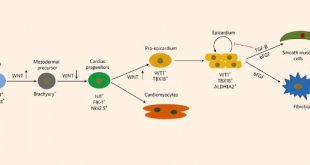
A process using human stem cells can generate heart cells belonging to the external layer, the epicardium, according to an international team of scientists from the Pennsylvania State University, the University of Wisconsin, Madison, Leiden University Medical Center in the Netherlands and AstraZeneca in Sweden. A model highlighting the specification …
Read More »Scientists advance theory that the Moon is made of many smaller moonlets
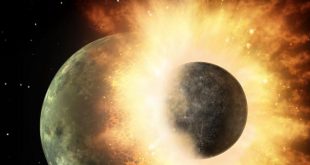
Theories abound to address how our moon was formed. After we brought moon rocks back from the lunar excursions of the 60s, certain facts became clear, like the striking similarity between Earth’s chemical composition and that of the moon. Like the blind men with the elephant, we’re still at a …
Read More »World’s Very First Polluted River? Scientists Find Evidence of Ancient Metallurgical Activity in Jordan
A research team led by Liverpool John Moores University scientists has discovered what could be the world’s very first polluted river, contaminated 7,000 years ago. In a now-dry riverbed in the Faynan Orefield of southern Jordan, the team found evidence of anthropogenic copper pollution. Wadi Faynan, where J.P. Grattan et …
Read More »Universe is Expanding Uniformly, Scientists Say
The Universe is not spinning or stretched in any particular direction, according to a team of researchers from University College London and Imperial College London, UK. A massive cluster of yellowish galaxies, seemingly caught in a red and blue spider web of eerily distorted background galaxies, makes for a spellbinding …
Read More »