September 20, 2021
Paleontogly
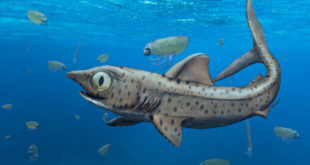
Paleontologists have uncovered seven well-preserved teeth from the extinct shark genus Petalodus in Shanxi province, China. Life restoration of Petalodus sharks. Image credit: Dinghua Yang. Petalodus is a small genus of Petalodontiformes, a intriguing group of extinct marine cartilaginous fish that flourished from the Carboniferous to the Permian period. First …
Read More »
September 20, 2021
Paleontogly
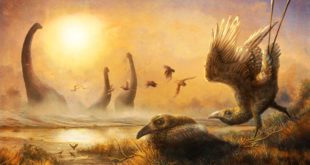
Paleontologists in China have identified a new species of pengornithid enantiornithine bird with a pair of elaborate tail feathers. An illustration showing what Yuanchuavis kompsosoura might have looked like in life. Image credit: Haozhen Zhang. Enantiornithes are the most successful group of Mesozoic birds, arguably representing the first global avian …
Read More »
February 12, 2021
Paleontogly
Flowering plants (angiosperms) are the most diverse of all land plants, becoming abundant in the Cretaceous period (145 to 66 million years ago) and achieving dominance in the Cenozoic (66 million years ago-present). However, the exact timing of their origin remains a controversial topic. To resolve this discrepancy, a team …
Read More »
January 25, 2021
Paleontogly
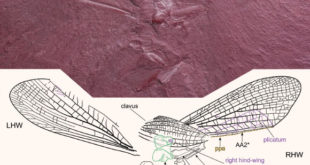
Paleontologists have identified a new fossil genus and species of primitive praying mantis from fore- and hind-wing imprints discovered in Labrador, Canada. Labradormantis guilbaulti. Image credit: Demers-Potvin et al., doi: 10.1111/syen.12457. Paleontologists know that most modern praying mantises, with their characteristic grasping forelegs, look very different from their oldest fossil …
Read More »
January 16, 2021
Paleontogly
An international team of paleontologists from Austria and Switzerland has uncovered an exceptionally well-preserved skeleton of Asteracanthus ornatissimus, a species of hybodontiform shark that lived about 150 million years ago (Jurassic period), in the famous limestones of Solnhofen in Germany. Tentative life reconstruction of the hybodontiform shark Asteracanthus ornatissimus. Image …
Read More »
December 28, 2020
Paleontogly
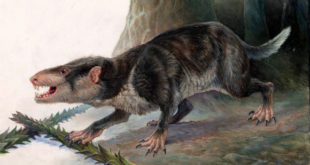
An early mammal called Priacodon fruitaensis was well adapted for powerful and precise biting, and had a varied faunivorous diet that likely included insects and small vertebrates, according to a University of Bonn-led study. Life restoration of the carnivorous mammal Gobiconodon, a distant relative of Priacodon fruitaensis. Image credit: Pavel …
Read More »
December 1, 2020
Paleontogly
Paleontologists in Madagascar have identified a new genus and species of enantiornithine bird that had a long and deep beak, a morphology that was previously unknown among Mesozoic birds. Falcatakely forsterae amidst non-avian dinosaurs and other animals from the Late Cretaceous of Madagascar. Image credit: Mark Witton. The newly-identified bird …
Read More »
November 23, 2020
Paleontogly
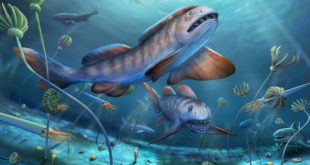
Paleontologists in Morocco have found fossil fragments from a previously undescribed genus and species of symmoriiform shark that lived during the Late Devonian epoch. Ferromirum oukherbouchi reconstructed in association with invertebrates (orthocerid cephalopods and thylacocephalans) from the Devonian of Maider region, Morocco. Image credit: Frey et al., doi: 10.1038/s42003-020-01394-2. The …
Read More »
November 21, 2020
Archeaology
Archaeologists from the Israel Antiquities Authority have found a small jar containing four 1,000-year-old gold coins in Jerusalem, Israel. The 1,000-year-old juglet with found gold coins. Image credit: Dafna Gazit, Israel Antiquities Authority. “The coins were in excellent preservation and were immediately identifiable even without cleaning,” said Dr. Robert Kool, …
Read More »
September 13, 2020
Paleontogly
Paleontologists have examined the fossilized remains of a previously unknown species of eurypterid (sea scorpion) and found direct evidence that these marine creatures were able to breathe in subaerial environments through their main respiratory organs. Lamsdell et al present details of the respiratory organs of Adelophthalmus pyrrhae from the Carboniferous …
Read More »