

It is notoriously difficult for transplant patients around the world to secure life-saving donor organs, thanks to limited supply, long waitlists, and complex qualification criteria. While some biomedical researchers hope to mitigate this problem by reviving dead tissue and 3D printing human organs, a favored strategy, xenotransplantation, involves taking an …
Read More »Google AI Supports Human Image Generation Again


Google has announced the rollout of a new version of its Imagen 3 AI image creator in Gemini. In addition to the usual spate of refinements and promises of prettier pictures, Google is once again allowing its model to generate images of people. This comes after it paused human generation …
Read More »Biocomputers Could Overpower AI

It’s called organoid intelligence, or OI, and it uses actual human brain cells to make computing “more brain-like.” OI revolves around using organoids, or clusters of living tissue grown from stem cells that behave similarly to organs, as biological hardware that powers algorithmic systems. The hope—over at Johns Hopkins, at …
Read More »DeepMind Builds AI

(Credit: Google)Google’s DeepMind AI division has already built machines that can wreck you in StarCraft II and predict millions of protein structures, but now it’s taking on an even harder task: writing coherent code. In an apparent effort to put themselves out of a job, DeepMind researchers have created an …
Read More »Sequencing Human Genome
Sequencing an entirely complete human genome has been the work of decades. Twenty years ago, the Human Genome Project (HGP) declared their work finished, with an asterisk. Even a decade later, fully eight percent of the genome — so-called “junk DNA” — was beyond our understanding. But the idea of …
Read More »Spaceflight Directorate
(Photo: Brian McGowan/Unsplash)NASA has announced it’s reshuffling its human spaceflight directorate to better accommodate low Earth orbit (LEO) operations and deep space exploration. The agency stated its Human Exploration and Operations Mission Directorate would be broken into two new divisions, one of which will prepare future operations on the moon …
Read More »DNA Found in Georgian Cave

An international team of scientists has retrieved and analyzed nuclear and mitochondrial environmental DNA of humans, wolfs (Canis lupus), and bisons (Bison bonasus) from a 25,000-year-old sediment sample from the Upper Paleolithic site of Satsurblia Cave, western Georgia, Caucasus. Gelabert et al. retrieved human and mammalian nuclear and mitochondrial environmental …
Read More »Bacteriophage Species

A team of biologists from the Wellcome Sanger Institute, the European Bioinformatics Institute and the Universidad de los Andes has identified 142,809 species of bacteriophages — viruses that infect and replicate in bacteria — living in the human gut. Camarillo-Guerrero et al. introduce the Gut Phage Database, a collection of …
Read More »UV-Induced Photodamage

Polyphenols, a group of natural compounds found in grapes as well as other fruits and vegetables, are key compounds responsible for ultraviolet (UV)-photoprotection, according to new research. Grapes may help protect against damage to the skin caused by solar UV radiation. Image credit: Bru-nO. “Major grape polyphenols include the flavanols …
Read More »Quadruple Helix DNA
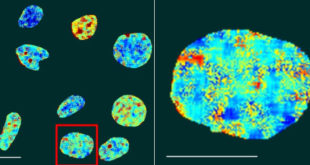
A team of scientists from the United Kingdom and Spain has demonstrated that a technique called fluorescence lifetime imaging microscopy in conjunction with a fluorescent probe can identify four-stranded ‘quadruple helix’ DNA structures within nuclei of live cells. Fluorescence lifetime imaging microscopy map of nuclear DNA in live cells stained …
Read More »