The James Webb Space Telescope has spotted something steamy. No, not that kind of steamy. Using its spectroscopic instruments, the observatory has found evidence that a distant exoplanet’s atmosphere could be chock-full of water in its gaseous state. If Webb is on the right track, its findings will represent the …
Read More »CERN Rare Decay
Physicists from the ATLAS (A Toroidal LHC ApparatuS) Collaboration at CERN’s Large Hadron Collider (LHC) have found first evidence of the Higgs boson decaying to a low-mass dilepton system (either an electron or a muon pair with opposite charge) and a photon. Known as Dalitz decay, this is one of …
Read More »Long Sought Axions
First theorized in the 1970s, axions are hypothetical particles that were proposed to preserve a time-reversal symmetry of the nuclear force. These particles may make up dark matter and may be produced thermally inside the cores of neutron stars, escape the stars due to their feeble interactions with matter, and …
Read More »Triassic Mammal Relative
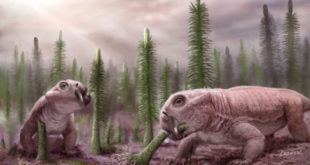
In a paper published in the journal Communications Biology, a team of U.S. paleontologists reports evidence of a hibernation-like condition in Lystrosaurus, an early relative of mammals that lived between 253 and 248 million years ago (Early Triassic epoch). The discovery was enabled by high-resolution of incremental growth marks preserved …
Read More »Physicists Find Quark
Physicists Find Strong Evidence of Four-Top Quark Production Physicists from the ATLAS Collaboration CERN’s Large Hadron Collider have uncovered strong evidence of the production of four top quarks. This rare process is expected to occur only once for every 70,000 pairs of top quarks created at the Large Hadron Collider. …
Read More »Reindeer Domestication
Earliest Evidence of Reindeer Domestication Found in Arctic Siberia An international team of archeologists has unearthed numerous L-shaped barbed antler objects at three early sites — Ust’-Polui, Tiutei-Sale I, and Iarte VI — in the Yamal region of Arctic Siberia. With help from contemporary Indigenous Nenets reindeer herders, the researchers …
Read More »Evidence of Supernova
Astronomers Find Evidence of Supernova Just 600 Light-Years from Earth Astronomers have found many awe-inspiring objects in the cosmos, but a pair of astronomers 20 years ago found something just plain confusing. They spotted a straight line of ionized gas in the direction of Ursa Major, which was never really …
Read More »New Evidence On Mars
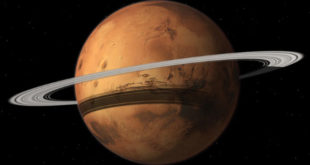
Researchers Find New Evidence that Mars Once Had Massive Ring Mars had a massive ring system several billion years ago, according to new research from the SETI Institute and Purdue University. An artist’s impression of a ringed Mars. Image credit: Tushar Mittal. Mars has two small satellites, Phobos and Deimos, …
Read More »Cassini Finds New Evidence for Hydrothermal Processes in Enceladus’ Ice-Covered Ocean
During NASA’s Cassini spacecraft’s deepest-ever dive through Enceladus’ plume of gas and ice grains, researchers discovered molecular hydrogen in the material spewing from the icy moon. This discovery provides further evidence for hydrothermal activity in the ocean beneath Enceladus’ surface and heightens the possibility that the ocean could have conditions …
Read More »MAVEN Finds New Evidence that Most of Martian Atmosphere Was Lost to Space
According to an analysis of new data from NASA’s MAVEN (Mars Atmosphere and Volatile Evolution) spacecraft, solar wind and radiation are responsible for stripping the atmosphere of Mars. By measuring light and heavy isotopes of argon in the planet’s atmosphere, the authors have determined that the majority of the planet’s …
Read More »