An international team of researchers has discovered a new dichromatic species of bat in the Guinean Nimba Mountains belonging in the genus Myotis. An artist’s impression of Myotis nimbaensis. Image credit: Patricia Wynne. Myotis is the most speciose genus of bats with over 120 living species and a range that …
Read More »Wild Bee Discovered
An international team of scientists has discovered a new species of the bee genus Lasioglossum living in sand dunes in Israel. Head of a female of Lasioglossum dorchini. Image credit: Nahal Alexander / A. Pauly. Lasioglossum is a genus of wild bees in the family Halictidae (commonly referred to as …
Read More »New Hermit Crab Discovered
Marine biologists from the University of Louisiana at Lafayette and the Smithsonian National Museum of Natural History have described a new species of the hermit crab genus Cancellus from a deep bank in the northwestern Gulf of Mexico. Cancellus heatherae, female holotype, shield length – 4 mm: (A) habitus, dorsal; …
Read More »Tree Hyrax Discovered
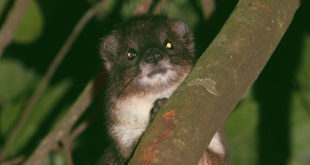
Zoologists believe they have found a previously unknown species of tree hyrax in the Taita Hills, Kenya. A female tree hyrax in Ngangao Forest, Taita Hills, Kenya. Image credit: Hanna Rosti. Tree hyraxes, members of the genus Dendrohyrax, are medium-sized (3-5 kg) mammals native to Africa. Also known as tree …
Read More »Ice Age Megafauna
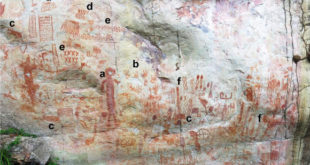
Archaeologists on the ERC project LASTJOURNEY have discovered spectacular rock pictographs in three separate rock shelters in the Guaviare Department of Colombia. The drawings, made around 12,600 and 11,800 years ago, provide proof the Amazon rainforest’s earliest inhabitants lived alongside now-extinct Ice Age animals such as giant sloths and mastodons. …
Read More »Jurassic Global Warming
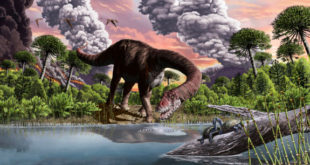
Paleontologists in Argentina have identified a new species of eusauropod (true sauropod) dinosaur that lived 179 million years ago, just after the mysterious disappearance of non-eusauropod sauropodomorphs. Life reconstruction of Bagualia alba. Image credit: Jorge González. The newly-identified dinosaur lived in what is now Patagonia, Argentina during the Early Jurassic …
Read More »New Species of Primate
An international team of biologists and taxonomists has discovered a new species in the langur genus Trachypithecus living in the forests of Myanmar. The Popa langur (Trachypithecus popa). Image credit: Thaung Win. Trachypithecus is a genus of non-human primates widely distributed in Asia with about 20 known species. Commonly known …
Read More »Ultraviolet Fluorescence
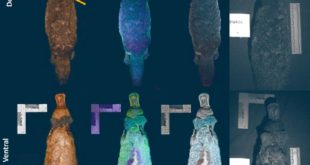
The fur of the platypus (Ornithorhynchus anatinus), one of only five extant species of monotremes (egg-laying mammals), absorbs ultraviolet light at wavelengths of 200-400 nm and re-emits visible light, making it fluoresce, according to new research from Northland College and the Warner College of Natural Resources at Colorado State University. …
Read More »New Organ Discovered
Our body contains a pair of previously overlooked and clinically relevant nasopharyngeal salivary glands, according to new research led by the Netherlands Cancer Institute and the University of Amsterdam. Sparing these newly-identified glands, named the ‘tubarial glands,’ in patients receiving radiotherapy may provide an opportunity to improve their quality of …
Read More »Magnetoelectric Effect
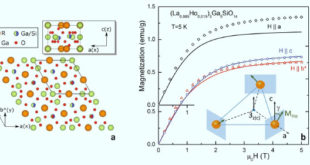
Even small changes in the direction of the magnetic field can switch the electrical properties of a paramagnetic rare-earth material — the holmium-doped langasite (HoxLa3-xGa5SiO14) — to a completely different state, according to new research published in the journal npj Quantum Materials. Crystal structure and magnetism in rare-earth langasite: (a) …
Read More »