Our efforts to find hints of extraterrestrial life have been focused on Mars, but an increasing number of scientists are turning to Venus as a potential home for alien organisms. At a recent meeting of astronomers in the UK, two separate teams presented evidence for potential biosignatures in the clouds …
Read More »New OpenAI Tool Can Detect Dall-E 3 AI Images With 98% Accuracy
The rapid proliferation of generative artificial intelligence is making it hard to know what’s real on the internet. More than any other company, ChatGPT maker OpenAI is driving this change. It has promised tools to identify AI content, and it’s finally delivering. Developers can now apply to help test its …
Read More »Blasting Through Space
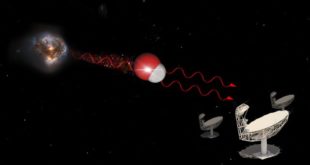
When we talk about astronomers spotting something in the far-off corners of the cosmos, it’s usually a galaxy, a star, or some other celestial object. Not this time. A team from South Africa has discovered an ultra-powerful radio-wave laser, a phenomenon known as a megamaser. At more than five billion …
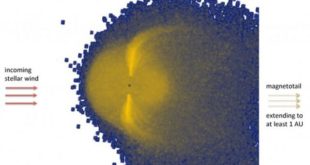
Read More »Astronomers Detect Exoplanet’s Magnetic
Flash on Jupiter
On the evening of Sept. 13, something hit Jupiter, producing an explosion and a flash of light visible even to amateur astronomers with off-the-shelf telescopes. Now, the hunt is on to figure out what the impactor could have been. The collision was first reported by Brazilian amateur astronomer José Luis …
Read More »Bumblebees of Flowers
Buff-tailed bumblebees (Bombus terrestris) are able to use differences in floral humidity to distinguish between rewarding and non-rewarding flowers, according to new research led by biologists from the University of Bristol and the University of Exeter. By experimentally varying the levels of floral humidity in artificial flowers within a range …
Read More »Moon Forming Disc
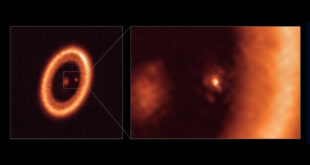
The sky is full of stars, and for the first time in human history, we know what’s orbiting some of them. There are more than 4,000 confirmed exoplanets, but just a few have been directly imaged. A young gas giant called PDS 70c is one of them, and now astronomers …
Read More »Isotopes on Exoplanet
Thanks to amazing scientific advancements like NASA’s Kepler Space Telescope and Transiting Exoplanet Survey Satellite (TESS), we have confirmed the existence of thousands of exoplanets. Most of these alien worlds are obscured by the light from their stars, limiting what we can learn about them. For the first time, scientists …
Read More »Solar CNO Neutrinos
For most of their existence, stars are fuelled by the fusion of hydrogen into helium. Fusion proceeds via two processes that are well understood theoretically: the proton-proton (p-p) chain and the carbon-nitrogen-oxygen (CNO) cycle. Neutrinos that are emitted along such processes in the solar core are the only direct probe …
Read More »Eerie Green Glow
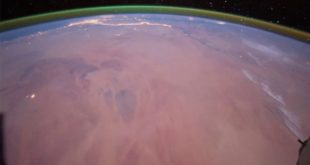
Astronomers Detect Eerie Green Glow on Mars for the First Time The red planet is looking a bit less red today, but that might be a good thing. European Space Agency (ESA) scientists operating the Trace Gas Orbiter (TGO) have snapped a photo of Mars with an eerie green glow …
Read More »