February 17, 2018
Space Exploration
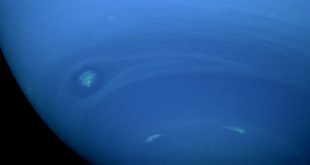
Neptune might not have the mass of Jupiter or the rings of Saturn, but it does have one distinction among planets in our solar system. Its winds are the fastest ever measured, even reaching supersonic speeds at times. Neptune’s tumultuous atmosphere gives rise to vortices similar to Jupiter’s Great Red …
Read More »
February 16, 2018
Space Exploration
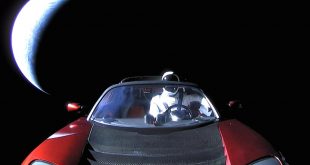
When Elon Musk launched his Roadster on the inaugural flight of the Falcon Heavy, it was (mostly) a fun PR stunt wrapped around a genuinely impressive event. The mission wasn’t entirely unscientific — the “Starman” at the wheel of the roadster was dressed in SpaceX’s commercial space suit and monitors …
Read More »
February 14, 2018
Space Exploration
Scientists are still puzzling over a mysterious object dubbed ‘Oumuamua detected by the Pan-STARRS (Panoramic Survey Telescope and Rapid Response System) observatory last year. Researchers confirmed that ‘Oumuamua was the first interstellar visitor ever discovered, but it was moving too fast for anyone to get a close look at it. …
Read More »
February 14, 2018
Space Exploration
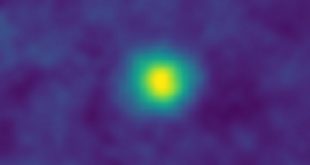
With its Long Range Reconnaissance Imager (LORRI), New Horizons has observed several objects in the Kuiper Belt, a distant region of icy debris that extends far beyond the orbit of Neptune. The false-color images of two of the observed objects — 2012 HZ84 and 2012 HE85 — are the farthest …
Read More »
February 14, 2018
Space Exploration
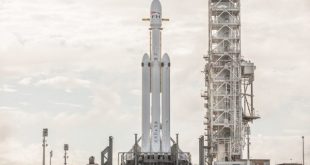
The first launch of SpaceX’s Falcon Heavy rocket last week was a smashing success, but not everything went perfectly. While SpaceX was able to recover two of the three first stage boosters, the center core failed to land on the drone ship. CEO Elon Musk has provided a bit more …
Read More »
February 13, 2018
Space Exploration
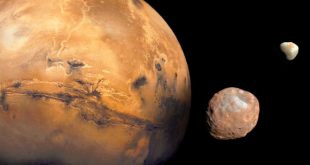
Like a teenage diary you can’t throw away, Mars might carry a reminder of its difficult formative years in its tiny moons. A paper published by the Royal Astronomical Society suggests the strangely small Phobos and Deimos could result from a traumatic slingshot rejection of the Red planet from the …
Read More »
February 13, 2018
Space Exploration
The China National Space Administration (CNSA) successfully launched its Long March-3B rocket on Monday, carrying a pair of satellites that will expand its Compass global navigation system. The launch took place at China’s Xichang Satellite Launch Center in Sichuan province. As you may know, Sichuan is smack dab in the …
Read More »
February 10, 2018
Space Exploration
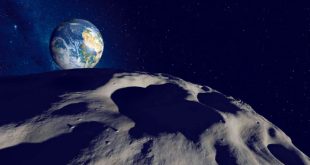
2018 CC and 2018 CB — two small asteroids recently discovered by NASA-funded astronomers — safely flew past our planet this week. This is an artist’s impression of an asteroid. Image credit: University of Colorado. Asteroid 2018 CC is estimated to be between 50 and 100 feet (15 and 30 …
Read More »
February 9, 2018
Space Exploration
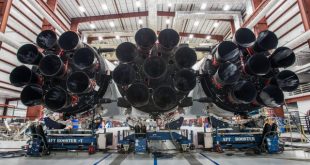
The successful launch of SpaceX’s Falcon Heavy rocket is a huge moment for the company and human space exploration as a whole. For the first time, we have a mostly reusable rocket with enough power to deliver large payloads to other planets. One peculiarity of the Falcon Heavy is its …
Read More »
February 7, 2018
Space Exploration
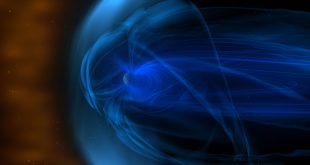
Last week, we reported on the strange case of NASA’s Image satellite. The Imager for Magnetopause-to-Aurora Global Exploration (IMAGE) was designed to observe and report on the magnetosphere of Earth. It launched in 2000 and worked flawlessly for five years before suddenly shutting down in 2005. After reboot attempts failed …
Read More »