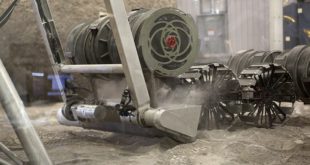
Humanity is building powerful rockets like the SpaceX BFR and NASA Space Launch System that can take a payload far away from Earth. However, making the return trip means you have to lug a lot more fuel with you. Efforts to send humans to Mars in the coming decades would …
Read More »The Great Wave that Brought Water to Mercury
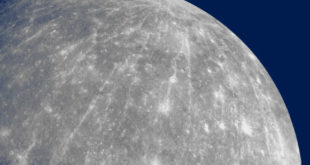
The impact that formed Mercury’s spectacular 100-km (62-mile) wide Hokusai crater, named after the famous Japanese artist, who created the Great Wave off Kanagawa, could have delivered the billions of tonnes of water ice stored at its poles. That’s according to a new study, which could also help explain why, …
Read More »So Long, and Thanks for All the Planets: NASA Retires the Kepler Telescope
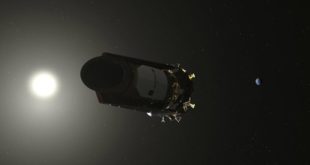
After nearly ten years and 2,681 planets, it’s time to say good-bye to the Kepler space telescope. NASA has announced that the mission has ended. Unlike more open-ended missions like Curiosity or Opportunity, Kepler always had a definitive shelf-life. In order to detect the minute variations around distant stars that …
Read More »Astronomers Confirm Collision Between Nearby Dwarf Galaxies
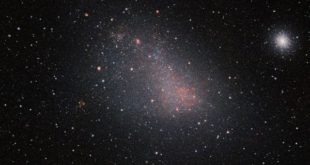
The Milky Way is not hanging alone in space — several dwarf galaxies are hovering nearby, and one of them has been a particular target of study for astronomers. Using a new space telescope, researchers from the University of Michigan have determined that the Small Magellanic Cloud is flying apart …
Read More »ESA’s Mars Express Orbiter Spots Elongated Cloud in Martian Atmosphere
Since September 13, 2018, ESA’s Mars Express spacecraft has been observing the evolution of a water ice cloud formation hovering in the vicinity of Arsia Mons, the southernmost in a trio of giant Martian volcanoes known collectively as Tharsis Montes. The white, elongated cloud in the vicinity of the Arsia …
Read More »Flyby Reveals Phaethon, Our Solar System’s Weirdest Asteroid-Comet Hybrid
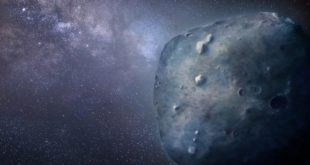
The Solar System is full of some really weird stuff. Venus, despite being farther from the Sun than Mercury, has a considerably higher surface temperature. Uranus is tilted on its side and rotates in one direction, while its moons orbit it normally. Jupiter’s moon Io is the most volcanically active …
Read More »NASA’s Chandra X-ray Observatory Is Back Online
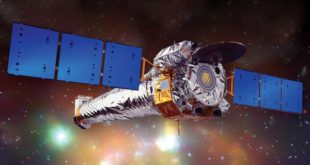
October started out rough for NASA with the failure of the Hubble and Chandra observatories in the space of a week. However, Hubble is coming back online after the team got its backup gyroscope working again. Now, Chandra is working again after NASA engineers implemented a fix for its gyroscope …
Read More »NASA May Have Fixed Hubble By Shaking It and Turning It Off and On
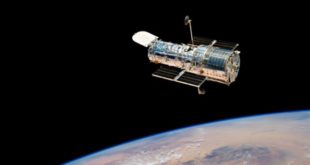
It has been a harrowing few weeks for the Hubble Space Telescope, but NASA believes it is one step closer to restoring the instrument to full functionality. NASA engineers initially feared the telescope’s backup gyroscope was busted, which would have limited Hubble’s ability to observe the universe. However, a series …
Read More »Salty, Oxygenated Water on Mars Could Host Simple Aerobic Life
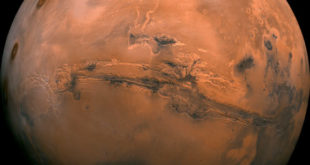
Caltech researcher Vlada Stamenković and co-authors calculated that if liquid water exists on the Red Planet, it could contain more oxygen than previously thought possible. Stamenković et al find that modern Mars can support liquid environments with dissolved oxygen values ranging from 2.5*10−6 mol /m3 to 2 mol/m3 across the planet, with particularly …
Read More »European-Japanese BepiColombo Spacecraft is on Its Way to Mercury
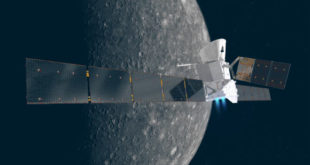
BepiColombo, a joint endeavor between the European Space Agency (ESA) and the Japan Aerospace Exploration Agency (JAXA), blasted off from Europe’s Spaceport in Kourou, French Guiana, at 01:45 GMT on October 20, 2018. It will make a seven year cruise to Mercury, the smallest and least explored planet in the …
Read More »