All of humanity save for a handful of astronauts have the advantage of living inside the protective bubble of Earth’s magnetic field. As space agencies and private companies look toward a future of people living on the moon and Mars, we have to contend with an unpleasant reality: the …
Read More »NASA Reveals Commercial Partners for New Moon Landings
NASA is going back to the moon, but it’s not doing it alone. The agency has just revealed its three commercial partners for phase one of the Artemis program. These US companies will help NASA deliver cargo and scientific instruments to the lunar surface in the next few years …
Read More »Insulating Shell of Gas Hydrates May Prevent Pluto’s Subsurface Ocean from Freezing
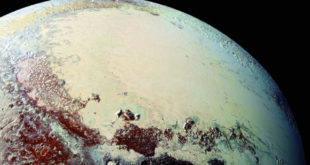
Many icy bodies in our Solar System have underground oceans. On the dwarf planet Pluto, an area called Sputnik Planitia suggests the presence of a subsurface ocean and a locally thinned ice shell. To maintain an ocean, the dwarf planet needs to retain heat inside. On the other hand, to …
Read More »Planetary Scientists Find Ancient Ice Caps beneath Martian North Pole
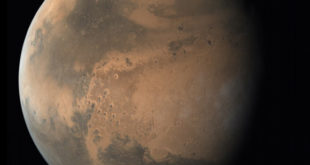
Planetary researchers using data from the Shallow Radar (SHARAD) instrument on NASA’s Mars Reconnaissance Orbiter have discovered rich deposits of water ice and sand hundreds of million years old beneath the current ice cap in the north polar region of the Red Planet. Published journal Geophysical Research Letters, the findings …
Read More »Martian Sand Dunes Behave Differently than Dunes on Earth: Study
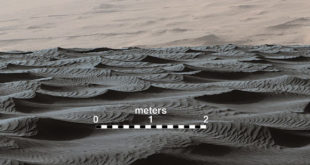
According to new research, published in the journal Geology, processes not involved in controlling sand movement on Earth play major roles on the Red Planet, especially large-scale features on the landscape and differences in landform surface temperature. Two sizes of ripples are evident in this December 13, 2015, view of …
Read More »Researchers Find ‘Oldest Collection of Non-Fossil Meteorites’ in Chile’s Atacama Desert
An international team of scientists has found a wealth of well-preserved stony meteorites in the Atacama Desert that allowed them to reconstruct the rate of falling meteorites over the past two million years. Meteorite with thin, dark, fusion crust in the Atacama Desert, Chile. Image credit: Jérôme Gattacceca, CEREGE. “Our …
Read More »NASA Orders First Segment of Lunar Station for 2024 Artemis Moon Mission
NASA is going back to the Moon, and this time, it intends to stay a while. That’s the news from NASA Administrator Jim Bridenstine, who announced the first company chosen to deliver a vital component of the space agency’s Lunar Gateway space station. Maxar Technologies will build the power …
Read More »Moon’s Nearside-Farside Asymmetries are Result of Ancient Giant Impact, Says New Study
The Moon has striking asymmetries between its nearside and farside in topography, crustal thickness, and composition. A new study, published in the Journal of Geophysical Research: Planets, suggests these asymmetries were caused by a dwarf planet colliding with the Moon in the early history of the Solar System. Global map …
Read More »Planetary Researchers Create Atlas of Moon’s South Pole
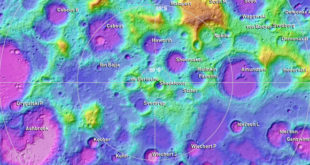
To assist NASA and the lunar community, a team of researchers from the Lunar and Planetary Institute (LPI) has compiled an online atlas that consists of a series of maps, images, and illustrations of the Moon’s south polar region. Topographic map of the Moon’s south pole (80°S to pole). Image …
Read More »Jupiter’s Winds Interact with Its Magnetic Field, Scientists Say
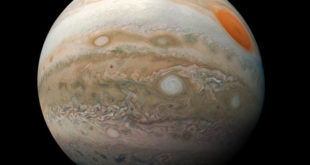
Planetary researchers from NASA’s Juno mission made the first detection beyond Earth of an internal magnetic field that changes over time — a phenomenon called secular variation. They also determined Jupiter’s secular variation is most likely driven by its atmospheric (or zonal) winds. This image of Jupiter was taken on February …
Read More »