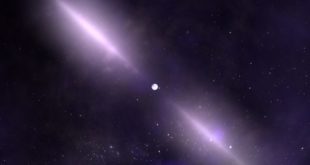
The universe is filled with almost incomprehensibly bizarre phenomena, but astronomers may be a step closer to understanding the life cycle of stars. Astronomers observing a distant star system have identified what may be the most massive neutron star ever discovered. This could help shed light on the murky …
Read More »Meet Dragonfly: The Diminutive Drone Set to Soar Across the Skies of Titan
When NASA’s new drone Dragonfly arrives on Titan, Saturn’s largest moon, it won’t roll across the surface like Curiosity, Spirit, and Opportunity have on Mars. Instead, Dragonfly is a dual-rotor quadcopter that will fly from point to point, using a vertical takeoff and landing (VTOL) system. It leverages existing …
Read More »Saturn’s Rings are as Old as Solar System Itself, Study Suggests
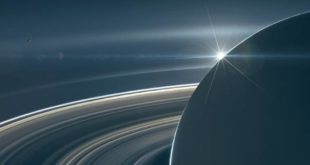
The famous ring system of Saturn may be much older than some planetary scientists think, according to a new study published in the journal Nature Astronomy. NASA’s Cassini spacecraft in orbit around Saturn. Image credit: NASA / JPL-Caltech. Southwest Research Institute researcher Luke Dones and his colleagues from CNRS and …
Read More »Dust from Disintegrated Asteroid Triggered Mid-Ordovician Ice Age
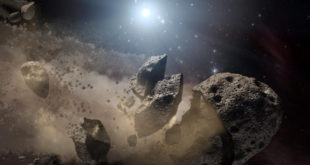
There’s always a lot of extraterrestrial dust floating down to Earth, but this dust is normally only a tiny fraction of the other dust in our atmosphere such as volcanic ash, dust from deserts and sea salt. But when a 93-mile (150 km) wide asteroid broke apart in the main …
Read More »Astronomers Capture Image of Second Known Interstellar Object
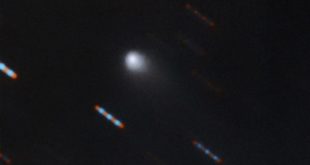
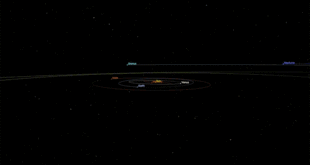
Astronomers around the world were elated in 2017 when ‘Oumuamua appeared in the sky, becoming the very first confirmed alien object to visit our solar system. Sadly, ‘Oumuamua was already on its way out of the solar system before its discovery by the Pan-STARRS observatory, and we couldn’t capture …
Read More »Water Detected on Planet Inside the Habitable Zone for the First Time
The astronomers who comb through data on planetary surveys looking for potentially habitable planets are searching for worlds with certain specific characteristics. We assume that any planet capable of supporting life has to exist within the habitable zone (also sometimes called the “Goldilocks zone”) of its host star. Too …
Read More »A Second Interstellar Visitor Is Approaching Our Solar System
In 2017, an interstellar object named ‘Oumuamua shot through our own solar system. It was the first time we’d ever detected an interstellar object passing through the solar system, and its unusual shape recalled the artificial vessel in Arthur C. Clarke’s Rendezvous with Rama science fiction novel. Now, an …
Read More »Titan’s Small Methane-Filled Lakes are Explosion Craters: Study
Small methane-filled lakes on the surface of Titan were likely formed by explosive, pressurized nitrogen just under the hazy moon’s surface, according to a new analysis of radar data from NASA’s Cassini spacecraft. This artist’s concept of a lake at the north pole of Titan illustrates raised rims and rampartlike …
Read More »Edscottite: Mineral ‘Never Seen in Nature’ Discovered inside Meteorite
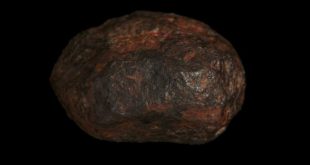
A meteorite found in Australia — called the Wedderburn iron meteorite because of where it was found — contains edscottite, an iron-carbide mineral never seen in nature before. Scanning electron microscopy image (colorized) showing edscottite in the polished Wedderburn section from the UCLA Meteorite Collection. Image credit: Ma Rubin, doi: …
Read More »ESA Calls for Space Traffic Rules After Near Miss With SpaceX Satellite
We talk often about how big space is, and indeed, it is really, mind-bogglingly big. However, space around Earth is feeling smaller all the time. SpaceX has launched the first few dozen of what will eventually grow to a swarm of thousands of satellites. Several days ago, the ESA …
Read More »