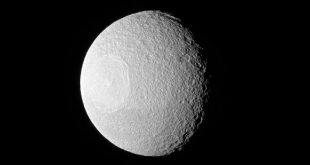
NASA’s Cassini spacecraft has sent back a breathtaking image of Tethys, a small, icy moon of Saturn. Cassini’s narrow-angle camera took this image of Tethys on November 10, 2016. The view was acquired at a distance of approximately 228,000 miles (367,000 km) from Tethys. Image credit: NASA / JPL-Caltech / …
Read More »Debris from ancient asteroid explosion still peppering our planet
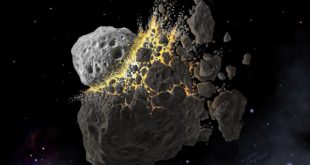
At a time when terrestrial plant life was just beginning to take hold here on Earth some 466 million years ago, a massive asteroid collision happened someplace nearby. We don’t know much about the nature of the original objects that collided, except that one of them was about the size …
Read More »Methane Gas May Have Caused Greenhouse Effect on Young Mars, Planetary Researchers Say
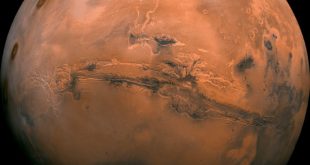
Methane present in the early Martian atmosphere, together with carbon dioxide and hydrogen may have created a greenhouse effect on the planet 3.5-4.5 billion years ago, according to a Harvard University-led team of researchers. Mosaic of the Valles Marineris hemisphere of Mars projected into point perspective, a view similar to …
Read More »Study: Today’s Rare Meteorites Were Common in Ordovician Period
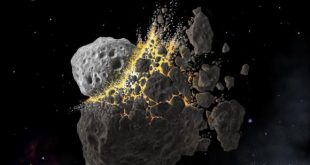
A new study published in the journal Nature Astronomy is the first to look at meteorites from before giant space collision 466 million years ago. This is an artist’s rendering of the space collision 466 million years ago that gave rise to many of the meteorites falling today. Image credit: …
Read More »NOAA’s GOES-16 Weather Satellite Captures Its First Images of Earth
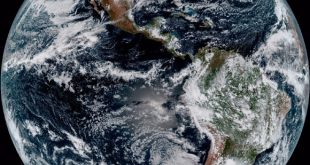
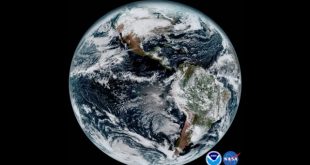
NOAA’s GOES-16 (formerly known as GOES-R), the first spacecraft in a new series of NASA-built advanced geostationary weather satellites, has sent the first high-resolution images from its Advanced Baseline Imager. This composite color full-disk visible image of the Western Hemisphere was captured from NOAA’s GOES-16 satellite on Jan. 15, 2017. …
Read More »NOAA’s new GOES-16 weather satellite sends back stunning first images
NASA and NOAA launched a new weather satellite back in November of 2016 called GOES-R. That craft is now online and sending back images, and it’s got a new (official) name. The newest and most advanced weather satellite keeping watch over America is GOES-16. To show off the impressive technological …
Read More »NASA’s SOFIA Observatory Collects New Data on Composition of Dwarf Planet Ceres
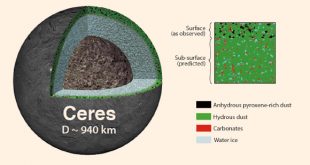
New observations from NASA’s Stratospheric Observatory for Infrared Astronomy (SOFIA) show that Ceres does not appear to have the carbon-rich surface composition that space- and ground-based telescopes previously indicated. The results were published in the Astronomical Journal on Jan. 16, 2017. Cross section of Ceres showing the surface layers that …
Read More »6 upcoming space missions worth keeping an eye on
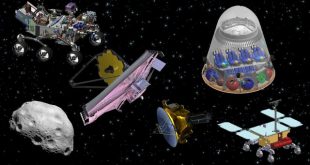
Having pretty thoroughly explored the Earth, humanity has since turned its attention to the stars. There are a myriad of missions already in the history books, and many more underway. We’re at a pivotal time in our exploration of space. With a bit of luck and science, we may soon …
Read More »SpaceX posts amazing photos of Falcon 9 landing
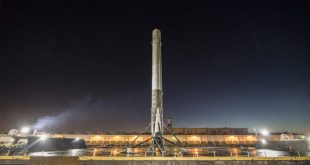
SpaceX took its time to get back on the launchpad after last year’s fueling “anomaly” that resulted in the loss of a Falcon 9 rocket and its cargo. The company conducted a months-long investigation and finally returned to space last weekend with a flawless launch and landing of the first …
Read More »Cassini Provides New View of Saturn’s Wave-Making Moon Daphnis
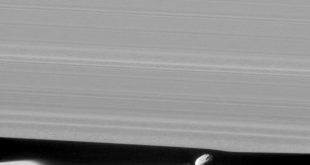
A new image from NASA’s Cassini spacecraft shows Saturn’s small moon Daphnis and the waves it raises in the surrounding ring material. This image was obtained in visible light with the Cassini spacecraft narrow-angle camera on January 16, 2017, at a distance of about 17,000 miles (28,000 km) from Daphnis. …
Read More »