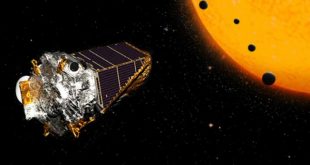
Earth is the only planet we know of right now that supports life, but considering the scale of the universe it seems like there could be others. The first step in finding these Earth-like worlds is to detect planets orbiting nearby stars. That’s what NASA’s Kepler space telescope has been …
Read More »NASA’s MAVEN Mission Celebrates 1,000 Earth Days in Orbit around Mars
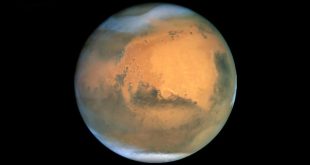
Today, NASA’s Mars Atmosphere and Volatile Evolution (MAVEN) mission — sent to Mars to explore its upper atmosphere, ionosphere and interactions with the Sun and solar wind — celebrates 1,000 Earth days in orbit around the Red Planet. This artist’s concept shows MAVEN in orbit around Mars, with a fanciful …
Read More »Cassini Sees Methane Clouds in Titan’s Summer Skies
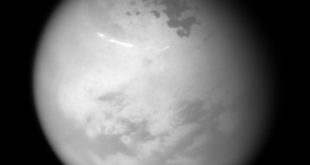
On June 9, 2017, NASA’s Cassini orbiter captured an image of methane clouds drifting in the summer skies of Saturn’s moon Titan. Titan’s summer skies. Image credit: NASA / JPL-Caltech / Space Science Institute. Compared to earlier in Cassini’s mission, most of the surface in Titan’s northern high latitudes is …
Read More »Google Wants Your Help Documenting This Summer’s Total Solar Eclipse
Solar eclipses happen every so often, but the one taking place on August 21st will be a first-of-its-kind event. That’s not because of the eclipse itself, but because of what the people in its path are doing. Google has partnered with the University of California Berkeley to collect an unprecedented …
Read More »Elon Musk’s Vision of Self-Sustaining Martian City, Manned Flights to Mars, Other Planets
An article entitled ‘Making Humans a Multi-Planetary Species’ presents the vision of Elon Musk, CEO of SpaceX, for future manned trips to Mars and other planets in the Solar System and specifically what will be needed to create a self-sustaining Martian city. Artist’s concept of humans working on Mars. Image …
Read More »NASA-Funded Startup to Build Fusion-Powered Rockets
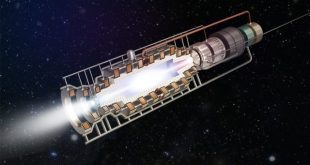
Nuclear fusion is the process that powers the sun, but closer to home scientists are trying to develop fusion reactors that could provide immense amounts of energy. These reactors are big and (currently) inefficient, but a NASA-funded startup called Princeton Satellite Systems is working on a small-scale fusion reactor that …
Read More »Cassini Beams Back New Image of Saturn’s Moon Iapetus
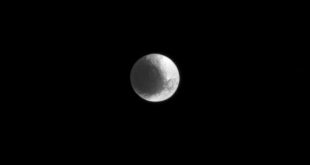
A new image of Saturn’s yin-yang moon, Iapetus, was recently captured by NASA’s Cassini probe, currently in its ‘Grand Finale’ phase. This image of Iapetus was taken with Cassini’s narrow-angle camera on March 11, 2017. Image credit: NASA / JPL-Caltech / Space Science Institute. Iapetus, also known as Saturn VIII, …
Read More »Jupiter is Solar System’s Oldest Planet, Planetary Researchers Say
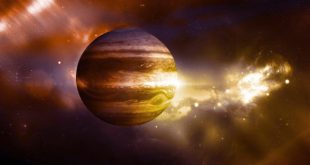
The gas giant Jupiter is not only the most massive planet in our Solar System, but it’s also the oldest, according to an international team of planetary researchers from the Institut für Planetologie at the University of Münster in Germany and Lawrence Livermore National Laboratory (LLNL) in the United States. …
Read More »NASA Unveils Mars Rover Concept With Detachable Science Lab
NASA is aiming to have humans on Mars in the next few decades, even if that comes with more risk than we originally thought. Just getting there is only the first challenge. Humans have to be able to survive and explore the red planet, and the agency just unveiled a …
Read More »Cosmic Rays Could Be Even More Dangerous to Mars Explorers Than Thought
Elon Musk wants to send humans to Mars by 2024, a proposition that seemed quite optimistic when it was announced last year. New research from the University of Nevada Las Vegas makes Musk’s goal that much less attainable. A new predictive model of radiation effects indicates we could be vastly …
Read More »