April 21, 2021
Paleontogly
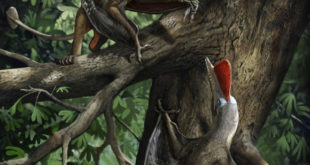
Opposed thumbs are adaptations to arboreal life and rare for non-mammal vertebrates; Kunpengopterus antipollicatus, a newly-discovered species of arboreal pterosaur that inhabited a unique forest ecosystem in what is now China during the Jurassic period, shows the oldest record of such a feature. Life reconstruction of Kunpengopterus antipollicatus in the …
Read More »
March 6, 2021
Paleontogly
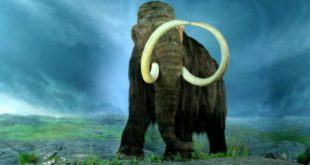
The so-called Mount Holly mammoth (Mammuthus sp.) lived approximately 12,800 years ago in what is now New England, a region comprising six states in the Northeastern United States, and potentially overlapped with the first human settlers of the region, according to new research from Dartmouth College. The woolly mammoth (Mammuthus …
Read More »
March 4, 2021
Paleontogly
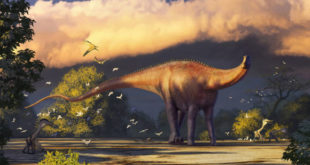
Paleontologists have identified a new genus and species of rebbachisaurid dinosaur from a fossil uncovered in Uzbekistan. Life reconstruction of Dzharatitanis kingi. Image credit: Alexander Averianov. The newly-discovered dinosaur roamed Earth approximately 92 million years ago, during the Turonian stage of the Late Cretaceous epoch. Dubbed Dzharatitanis kingi, it belongs …
Read More »
February 23, 2021
Paleontogly
A team of geobiologists from Germany has found biologically-relevant primordial organic molecules and gases in fluid inclusions trapped in 3.5-billion-year-old barites from the Dresser mine, Marble Bar, Australia. Location of the Dresser mine in Western Australia (a) and black barite associated with originally sulfidic stromatolites at the sampling site (b) …
Read More »
February 12, 2021
Paleontogly
Flowering plants (angiosperms) are the most diverse of all land plants, becoming abundant in the Cretaceous period (145 to 66 million years ago) and achieving dominance in the Cenozoic (66 million years ago-present). However, the exact timing of their origin remains a controversial topic. To resolve this discrepancy, a team …
Read More »
February 1, 2021
Paleontogly
The 635-million-year-old pyritized fungus-like microfossils found in the Ediacaran-period Doushantuo Formation in China provide direct fossil evidence for the colonization of land by fungi. The 635-million-year-old fungus-like filamentous microfossils from the Doushantuo Formation in China. Image credit: Andrew Czaja, University of Cincinnati. The Ediacaran-period fungus-like fossils were found in small …
Read More »
January 27, 2021
Paleontogly
The giant dinosaur Spinosaurus acted like modern herons or storks, taking fish and other aquatic prey from the edges of water or in shallow water, but also foraging for terrestrial prey and scavenging on occasion, according to new research by paleontologists from Queen Mary University of London, the University of …
Read More »
January 27, 2021
Paleontogly
An international team of paleontologists has examined the fossilized remains of baby tyrannosaurid dinosaurs found in Alberta, Canada, and Montana, the United States. An artist’s impression of a juvenile tyrannosaur. Image credit: Julius Csotonyi. Tyrannosaurids were the apex predators of the supercontinent Laurasia in the Late Cretaceous epoch, and were …
Read More »
January 27, 2021
Paleontogly
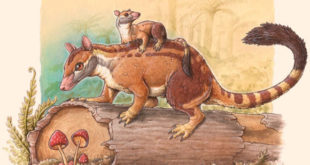
Dr. Laura Chornogubsky, a paleontologist in the Museo Argentino de Ciencias Naturales ‘Bernardino Rivadavia’ and CONICET, has described one new genus and three new species in the marsupial family Polydolopidae. Kramadolops maximus, the youngest known species of polydolopid marsupial. Image credit: Gabriel Lío. Polydolopidae is a family of extinct marsupials …
Read More »
January 25, 2021
Paleontogly
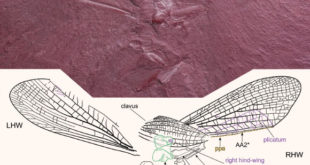
Paleontologists have identified a new fossil genus and species of primitive praying mantis from fore- and hind-wing imprints discovered in Labrador, Canada. Labradormantis guilbaulti. Image credit: Demers-Potvin et al., doi: 10.1111/syen.12457. Paleontologists know that most modern praying mantises, with their characteristic grasping forelegs, look very different from their oldest fossil …
Read More »